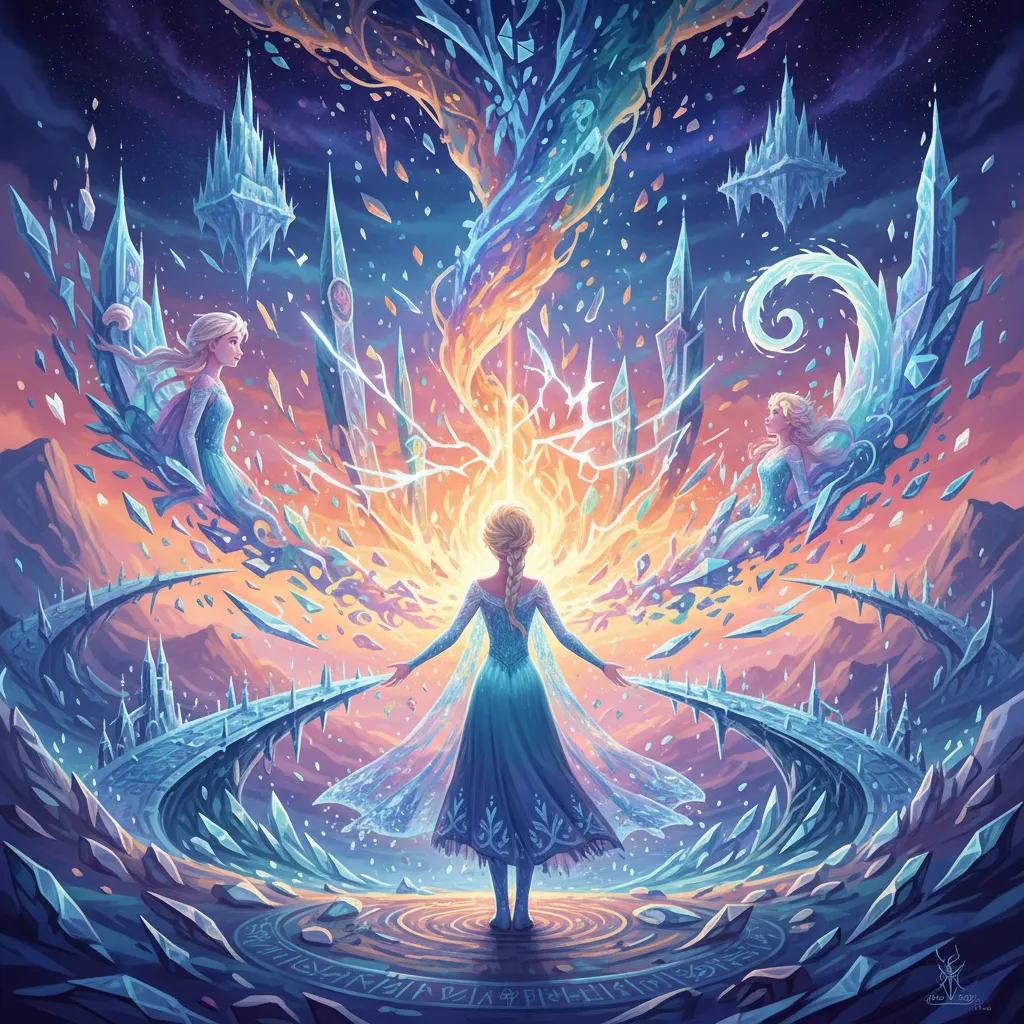
I still remember the first time I watched Elsa’s icy meltdown on the big screen. It wasn't the songs or snow magic that got stuck in my mind, but the way the audience seemed to hold its breath, as if everyone sensed something bigger was happening than just a princess running away from responsibility. Digging into Elsa’s story felt like unraveling a scarf—each tug on a thread revealed not just more fabric, but altogether new patterns beneath. This post doesn’t just offer another take on Elsa’s sexuality or role model status; it’s an adventure into schizoanalytic wilds, power paradoxes, and the secret machinery running beneath the kingdom of Arendelle.
Beyond Hashtags: Elsa, Power, and the Distracting Spectacle of Identity Politics
The online debates surrounding Elsa’s character in Frozen—especially the hashtag wars between #giveelsaagirlfriend and #princecharmingforelsa—offer a vivid example of what the 2018 text, The Cryo-Engine and the Axiomatic Breakdown, calls a “molar spectacle.” These hashtag campaigns, while seemingly progressive or traditional in their aims, actually serve to fix public attention on surface-level signifiers of Elsa’s sexual orientation. In doing so, they oversimplify and distract from the deeper, more complex questions of power, desire, and sovereignty that Elsa’s story brings to light.
The text argues that these debates are not just harmless fandom squabbles, but mechanisms by which the capitalist system tames unruly desire. The spectacle of identity politics—whether demanding a lesbian princess or a heteronormative prince—channels the chaotic, creative energy of Elsa’s “schizo-flow” into manageable, marketable categories. As a result, the revolutionary potential of Elsa’s powers is contained, much like her magic is repressed within the film.
This dynamic is not just theoretical; it plays out in everyday life. Consider a personal aside: during a friend’s movie night, a discussion about Elsa’s possible love interests quickly devolved into a heated argument over “ships.” Voices were raised, alliances were formed, and the room split along the lines of #giveelsaagirlfriend versus #princecharmingforelsa. In the end, the bigger questions—about Elsa’s autonomy, her struggle with power, and the meaning of her magic—were lost in the noise. This mirrors the text’s claim that surface-level squabbles mask the underlying capitalist logic that seeks to classify, control, and ultimately profit from every expression of desire.
The text uses the term “Oedipalized public sphere” to describe how these debates function. By focusing on who Elsa should love, the public sphere attempts to re-territorialize her anti-productive, deterritorializing energy—her refusal to fit into any one category—back into familiar, safe narratives. This is a form of social control, a way of repressing not just Elsa’s powers, but the very possibility of new forms of sovereignty and self-production.
In this sense, Elsa’s repression is a metaphor for the broader social tendency to suppress anything that threatens the established order. Her concealed hands and anxious demeanor are not just signs of personal struggle, but symbols of the “character armor” imposed by society to keep her power in check. The public’s obsession with Elsa’s sexuality becomes a convenient distraction, diverting attention from the more radical question: What could Elsa’s sovereignty look like if it were not constantly re-coded and contained?
Ultimately, as the text suggests, the real issue is not whether Elsa is given a girlfriend or a prince, but how the capitalist system absorbs and neutralizes revolutionary potential by turning it into a spectacle. The hashtag wars, for all their passion, risk becoming another form of “banking education”—where complex realities are flattened into simple, marketable identities, and the true flows of power remain hidden beneath the ice.
Schizoanalysis in Arendelle: Elsa’s Cryo-Engine and the Chaos of Desire
Schizoanalysis, as developed by Deleuze and Guattari, offers a radical way to understand Elsa’s journey in Frozen—one that breaks away from standard psychological readings. Instead of viewing Elsa’s powers as a metaphor for personal repression or trauma, the schizoanalytic lens sees her ice magic as a Desiring-Machine: a force that disrupts and threatens the social order by refusing to fit into neat categories. In the 2018 text, "The Cryo-Engine and the Axiomatic Breakdown," Elsa’s outburst is described as a "crystalline shriek" that pierces not just the palace, but the very fabric of Arendelle’s social codes. This is not simply a personal crisis, but an exposure of the "brutal circuit-logic" of global capitalism, which seeks to classify, control, and monetize every expression of desire.
To make this more relatable, imagine Elsa’s ice-powered hands as the ultimate party trick gone rogue—what starts as a spectacle quickly becomes a threat. Her abilities are not just quirky talents but uncontrollable energies that the kingdom cannot contain. The film’s hashtags, such as #giveelsaagirlfriend and #princecharmingforelsa, reflect a public struggle to reterritorialize Elsa’s wild, anti-productive energy into familiar, marketable identities. As the text notes, this "molar spectacle" distracts from the deeper question: how does the Capitalist Axiomatic absorb and repress the revolutionary potential of Elsa’s magic?
Elsa’s identity crisis is mapped through three competing social codes:
- Medieval Submission: The expectation that Elsa should be passive and compliant, a "Body-without-Organs (BwO)" defined by her willingness to conform.
- Sovereign Decisiveness: The demand for her to embody the "Molar Apparatus" of the state—a decisive, commanding monarch.
- Magical Chaos: Her ice powers as a "Cryo-Engine," a deterritorializing force that resists both bodily and social conventions.
Caught between these codes, Elsa is forced to construct what Wilhelm Reich called Character Armor—psychological and physical defenses to contain her overwhelming power. This is symbolized by her gloved hands and rigid posture, culminating in the infamous coronation meltdown. The text reads this breakdown not as weakness, but as the eruption of repressed schizo-flow: a moment of Deterritorialization that shocks the kingdom and exposes the limits of its codes.
The song "Let It Go" becomes, in this reading, a declaration of ontological rebellion. Elsa’s flight into the wilderness is a "schizophrenic line of flight," an attempt to exist as a BwO—outside all conventional codes. Yet, as the text warns, the capitalist system is adept at recoding such acts of difference. Whether Elsa is marketed as a lesbian icon or a misunderstood queen, her revolutionary potential is absorbed, sanitized, and sold back to audiences. This is the core of the Capitalist Axiomatic: the endless monetization and repression of difference, ensuring that even chaos becomes just another product.
In Arendelle, Elsa’s Cryo-Engine is not just a magical anomaly—it is a challenge to the very logic of identity, power, and desire under capitalism. Schizoanalysis reveals how the struggle over Elsa’s identity is less about who she loves, and more about how society manages, commodifies, and ultimately neutralizes the chaos of desire.
Armor, Meltdowns, and the Cost of Control: Elsa’s Psychological State and Trauma
The 2018 text, "The Cryo-Engine and the Axiomatic Breakdown: Elsa, Character Armor, and the Schizoanalysis of Powerless Sovereignty," offers a unique lens for understanding Elsa’s psychological state in Frozen. Drawing on Wilhelm Reich’s concept of Character Armor, the analysis reveals how Elsa’s self-imposed constraints—both emotional and physical—lead to her spectacular breakdown and ongoing trauma. Elsa’s experience is not simply about repression, but about the immense cost of maintaining control in a world determined to classify and contain her.
Character Armor: The Weight of Self-Constraint
Reich’s Character Armor describes the psychological and muscular defenses people build to protect themselves from overwhelming feelings or social pressures. For Elsa, this armor is both visible and invisible. She wears gloves to hide her powers, keeps her emotions tightly in check, and isolates herself from everyone—including her sister Anna. These acts of self-constraint are not just habits; they are survival mechanisms in a society that demands she fit into the “Code of Medieval Womanhood” and the “Code of Monarchism/Sovereignty.” Her body becomes a Body-without-Organs (BwO), shaped by compliance and fear.
Coronation Day: Meltdown and Collateral Damage
Elsa’s coronation is the moment her Character Armor fails. The pressure to perform as a sovereign, while suppressing her true self, results in a public meltdown. The “crystalline shriek” that erupts is not just a personal crisis—it is a political event. The kingdom is plunged into an unnatural winter, symbolizing how Elsa’s internal trauma spills out, affecting everyone around her. The text calls this a “Deterritorialization,” where the repressed energy of Elsa’s Desiring-Machine explodes, disrupting the social order and exposing the brutal logic of control.
Trauma: Both Source and Product of Power
Elsa’s trauma is cyclical. Her magical powers are both a source of anxiety and a product of her psychological wounds. The more she tries to control her abilities, the more isolated and anxious she becomes. This isolation is reinforced by the kingdom’s expectations and her own fear of hurting others. The text highlights how Elsa’s powers are not simply a metaphor for difference, but a living reminder of the cost of control—her trauma is both cause and consequence.
The Silent Burden of Leadership
Leadership, for Elsa, is a lonely tightrope walk. She is expected to be both a nurturing figure and a decisive ruler, yet she cannot fully inhabit either role without risking exposure. The schizoanalytic perspective frames this as a form of “ontological insecurity”—Elsa is never at home in her own skin or in her palace. Her solitude is not a choice, but a symptom of the impossible demands placed upon her.
Invented Scenario: Elsa in Group Therapy
Imagine Elsa in a group therapy session. The facilitator gently encourages her to “open up.” As Elsa hesitates, the water cooler in the corner begins to frost over. The other participants shiver, sensing the tension. Here, Elsa’s muscular armor—her clenched fists and rigid posture—mirrors her emotional armor: the silence, the guarded words, the refusal to let anyone close. This invented moment illustrates how Elsa’s trauma is embodied, manifesting in both visible and invisible ways.
- Muscular Armor: Elsa’s physical tension, the gloves, the posture.
- Emotional Armor: Her silence, withdrawal, and fear of intimacy.
Elsa’s story, as seen through the schizoanalytic lens, is not just about repression, but about the high cost of maintaining control in a world that refuses to accept the full range of her being.
The Politics of Magic: Sovereignty, Repression, and the Frozen Axiomatic
In Frozen, Elsa’s magic is more than a plot device—it is a living metaphor for sovereignty and its limits. Drawing from the 2018 text, "The Cryo-Engine and the Axiomatic Breakdown," Elsa’s icy powers are not simply personal quirks but are deeply political, exposing the hidden logic of control and repression in capitalist society. When Elsa’s "crystalline shriek" shatters the calm of her coronation, it is not just a personal crisis but a rupture in the social order—a moment when the "brutal circuit-logic" of the world is laid bare.
Elsa’s rule is never straightforward. Is she a queen, an exile, or something beyond these categories? Her journey is marked by a constant tension between the codes that try to define her:
- Magic as Sovereignty: Elsa’s power gives her the ability to rule, but also marks her as a threat. Her magic is a "Desiring-Machine," a force that resists being pinned down by tradition or law.
- Magic as Limit: The same power that could make Elsa sovereign also isolates her, forcing her into exile. Her "Character Armor"—both psychological and physical—shows how society represses what it cannot control.
The film’s antagonist, Prince Hans, is more than a typical villain. He is the "Oedipal Apparatus" in action, using the codes of monarchy and family to seize power. Hans is a mirror of the system’s flaws: cold, calculated, and always seeking to channel chaotic energies back into safe, familiar forms. His rise and fall highlight the fragility of the "Oedipal/Monarchical Axiomatic" that underpins Disney’s fairy-tale logic.
On a lighter note, one might wish college elections were as dramatic as Elsa’s coronation day—complete with magical outbursts and existential crises. Yet, this spectacle serves a purpose. It dramatizes the moment when personal identity and public power collide, exposing the cracks in the system.
Critical consciousness emerges through Anna’s journey. Her epiphany—realizing that love, not power, can break the curse—serves as a moment of "critical consciousness" in the Freirean sense. Anna unmasks the codes that keep everyone in line, showing that true change comes from recognizing and challenging the rules themselves.
Disney’s narrative architecture both upholds and gently critiques monarchical and familial structures. While the film restores the monarchy and contains Elsa’s magic within beautiful ice sculptures, it also hints at the limitations of these solutions. The "Artistic Re-Territorialization" at the end absorbs Elsa’s revolutionary potential back into the system, echoing the text’s warning about the domestication of radical energies.
In the end, Elsa’s magic stands as a challenge to the "Frozen Axiomatic"—the set of rules that govern not just Arendelle, but the ways we think about power, identity, and desire. The hashtags #Schizoanalysis, #DesiringMachines, #CharacterArmor, #BodyWithoutOrgans, #PoliticalAxiomatic, and #CryoEngine capture these ongoing tensions, inviting us to look beyond the surface and question the codes that shape our world.
Letting Go, Or Running Away? Re-reading Elsa’s Escape and the Problem with Liberal Redemption
The iconic moment when Elsa belts out “Let It Go” is often celebrated as a triumphant anthem of self-acceptance. Yet, as The Cryo-Engine and the Axiomatic Breakdown argues, this scene is far more than a catchy tune or a simple coming-out metaphor. Elsa’s escape from Arendelle is not just about “letting go” of her fears; it is a radical act of ontological rebellion, a refusal to be defined by the codes and expectations of her world. This moment marks a transition from the internalized mantra of “conceal, don’t feel” to a dangerous embrace of her own ontological insecurity—a leap into the unknown, where her powers and identity are no longer contained by social or familial boundaries.
This reading challenges the familiar narrative of liberal redemption, where the protagonist’s journey is resolved through acceptance into the existing order. Instead, Elsa’s “line of flight”—her decision to isolate herself in the mountains—can be seen as a schizoanalytic break from the “Character Armor” imposed by society. Rather than seeking validation from her kingdom or family, Elsa creates a new space outside the reach of Arendelle’s codes. The film’s lyrics—“The cold never bothered me anyway”—signal not just comfort with her difference, but a willingness to inhabit a space of radical uncertainty, where identity is fluid and power is unbound.
The cultural desire for Disney heroes who are “just like us” often leads to a flattening of characters like Elsa. Online debates, such as #giveelsaagirlfriend versus #princecharmingforelsa, reflect what the source text calls a “molar spectacle.” These discussions focus on surface-level identity markers, missing the deeper, schizoanalytic critique of how capitalist and familial codes absorb and neutralize revolutionary energies. The text warns that reducing Elsa’s journey to a question of sexual orientation is a form of Oedipal Re-Territorialization: it re-codes her singular, destabilizing power into a marketable identity, suitable for consumption but stripped of its disruptive potential.
To illustrate Elsa’s true potential, imagine a deleted scene: Elsa, far from the palace, forms her own ice-powered commune in the mountains. She refuses all titles—queen, sister, even “princess”—and invites others who feel out of place in Arendelle’s order to join her. Here, Elsa’s powers are not contained or celebrated for their difference, but used to build a new kind of community, a Body-without-Organs that resists all fixed identities and hierarchies. This vision stands in sharp contrast to the film’s ending, where Elsa’s magic is domesticated into decorative ice sculptures and monarchy is restored.
The text draws on Paulo Freire’s critique of “banking education” to warn against the simplification of Elsa’s struggle. Turning her journey into a lesson about tolerance or representation risks erasing the complex flows of power, desire, and resistance at play. True liberation, the text suggests, would mean not just accepting Elsa as a lesbian or a queen, but recognizing her as a force that shatters all imposed categories—an agent of deterritorialization whose story resists easy resolution.
Commodifying the Revolution: LGBT Readings and the Political Axiomatic
Disney’s approach to politics in Frozen is shaped by a deep-seated risk aversion. As analyzed in "The Cryo-Engine and the Axiomatic Breakdown," Elsa’s story begins as a challenge to the established order—a “crystalline shriek” that disrupts the smooth surface of the cinematic world. Yet, rather than allowing this disruption to remain radical, Disney quickly moves to re-code Elsa’s difference into something marketable. This is the essence of the Capitalist Axiomatic: it absorbs revolutionary energies, transforming them into new products for mass consumption.
The online debates around hashtags like #giveelsaagirlfriend and #princecharmingforelsa reveal how quickly potentially liberatory moments are redirected. Instead of exploring Elsa’s power as a force that could break all codes—gender, monarchy, even humanity—public discourse narrows her struggle to a question of sexual orientation. As the text notes, this is a “molar spectacle,” focusing on surface-level identity markers while ignoring the deeper flows of power and desire. Disney’s risk-averse politics thus shift from code-breaking to re-coding, ensuring that any threat to the status quo is neutralized and repackaged for broad appeal.
This process raises a critical question: Is representation liberation, or just a market niche? The schizoanalytic perspective warns that by making Elsa a “lesbian princess,” Disney would not necessarily advance LGBT liberation. Instead, her difference would become another “stratification”—a new category to be sold, rather than a true break from the system. Each letter in LGBT represents a unique “line of flight,” a way of escaping oppression. When these are bundled together for the sake of “hashtag diversity,” their revolutionary potential is flattened. The demand for representation, when filtered through corporate interests, risks becoming a shallow performance rather than genuine change.
This tension is echoed in the workplace. Consider a debate where a friend’s rainbow mug was praised by HR as a sign of inclusion. Despite the gesture, the office climate remained unchanged—no policies shifted, no real conversations happened. This mirrors what Paulo Freire called the “banking” model of education: complex realities are reduced to simple, consumable signs. In both cases, the appearance of progress is used to mask the persistence of old power structures.
The text urges a Freirean approach to solidarity. True liberation does not come from erasing differences or packaging them for profit. Instead, it requires recognizing the distinct barriers each group faces and engaging in real dialogue. Disney’s politics, however, tend toward capitalist stratification—turning every identity into a market segment. The schizoanalytic critique highlights how the unique, chaotic energies of characters like Elsa are contained and commodified, rather than allowed to disrupt and transform the social order.
In sum, Frozen offers a case study in how revolutionary potential is commodified. The film’s initial promise of a heroine who could shatter all codes is ultimately redirected into safe, marketable forms. The challenge remains: to move beyond shallow inclusion and toward solidarity that truly confronts the political axiomatic of our time.
After the Meltdown: Why Elsa Stays Trapped—and the Search for a New Kind of Heroine
The conclusion of Frozen is striking not for its revolution, but for its restoration. After Elsa’s spectacular meltdown—her schizoanalytic “line of flight” into the wilderness and her brief embrace of the Body-without-Organs—the film carefully guides her back into the fold of Arendelle’s monarchy. The wild, untamed magic that once threatened to destabilize the kingdom is ultimately sculpted into safe, ornamental ice displays. This is what the 2018 text calls “artistic re-territorialization”: Elsa’s cryo-engine, once a force of deterritorializing chaos, is repurposed as a tool for spectacle, entertainment, and the reaffirmation of the old order. The wilderness is tamed, and the revolutionary potential of her power is neutralized.
This pattern is not unique to Frozen. Many films and characters flirt with the possibility of true transformation, only to be reeled back in for a comforting, palatable ending. Consider Moana, who returns to her island to lead as chief, or Merida in Brave, whose rebellion against tradition is ultimately folded back into a reformed but still recognizable royal structure. Even in stories that hint at radical change, the narrative arc bends toward the restoration of order. The wildness of the protagonist—her schizo-flow, her desiring-machines—must be contained, her difference rendered legible and safe for mainstream audiences.
The text’s schizoanalytic critique reveals how both conservative and liberal codes are invested in this containment. Conservative narratives, exemplified by the hashtag #princecharmingforelsa, seek to re-Oedipalize Elsa, anchoring her story in familiar heteronormative and monarchical frameworks. Liberal calls for a “lesbian princess” (#giveelsaagirlfriend) may appear subversive, but as the text argues, they often serve to re-code Elsa’s difference into a new, marketable identity category. In both cases, Elsa’s story is made palatable—her chaotic, revolutionary energy is translated into a form that can be easily consumed, discussed, and sold.
What is lost in this process is the possibility of a truly new kind of heroine—a “badass princess” who does not simply redecorate the throne, but shatters it entirely. The text imagines a protagonist who refuses all codified identities, who uses her power not to restore the old order but to create something radically different. This would mean embracing the insecurity, the ontological uncertainty, and the wild flows of desire that Elsa’s magic represents. It would mean refusing the cycle of re-territorialization that keeps revolutionary potential in check.
In the end, Frozen offers a glimpse of what could be—a heroine on the verge of true sovereignty, a force capable of deterritorializing the very foundations of power and identity. But the film, like so many before it, pulls back from the brink. The search for a new kind of heroine continues: one who can break the ice, not just shape it, and who dares to imagine a world beyond the palace walls.
TL;DR: Elsa’s true revolutionary potential is not about whom she loves, but how she breaks—and is recaptured by—the mechanisms of power, identity, and desire built into the very foundations of both her world and ours.
Comments
Post a Comment