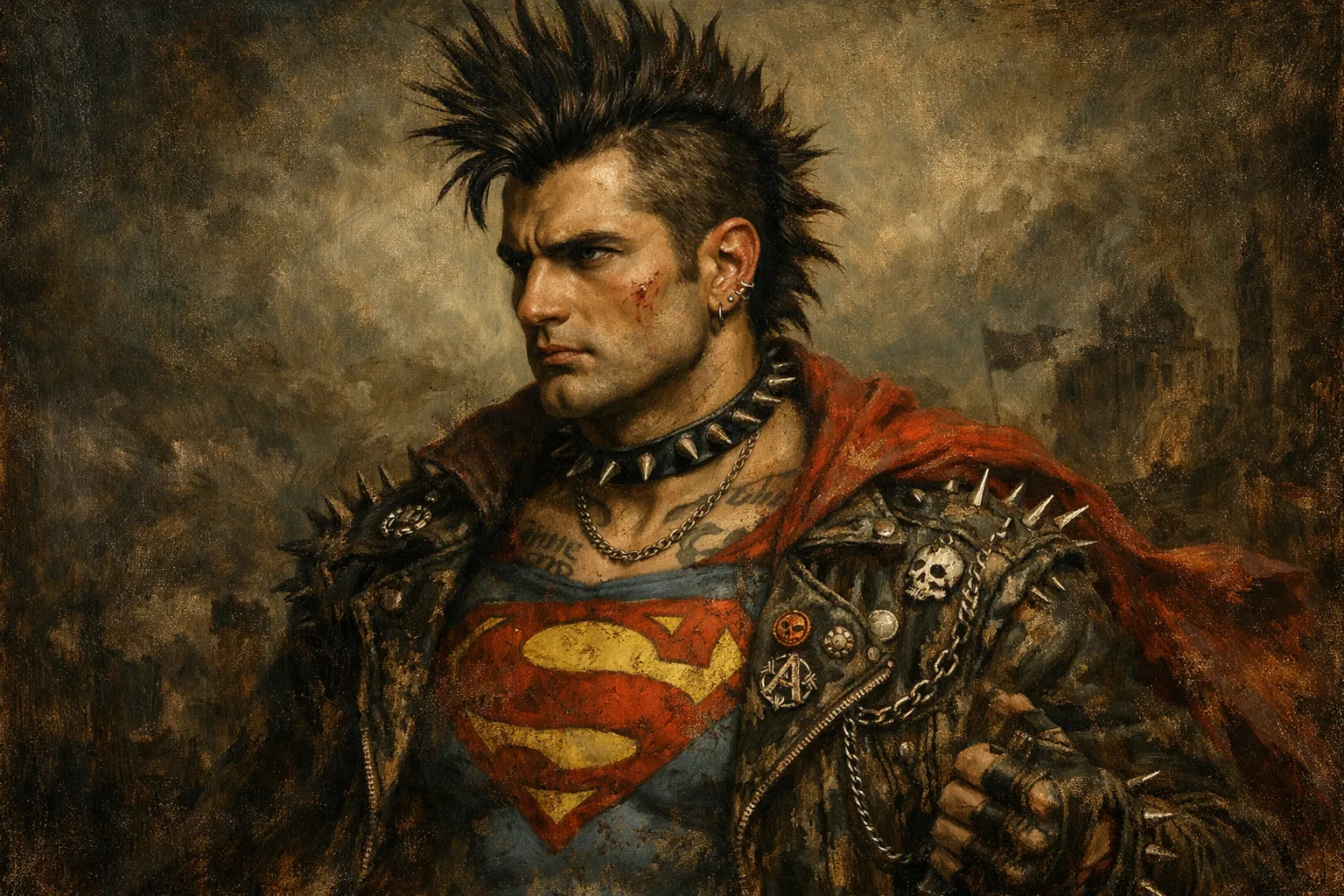
To fly is not to escape, but to inhabit the highest stratum of the state, whereas to snap a selfie in the face of annihilation is to discover the only true line of flight remaining in Metropolis.
The Molar Sun and the Striation of the Ideal
Superman operates as a biological and political axiom, his very cells functioning as an engine of re-territorialization. The yellow sun of the galaxy is not just a source of power but a tonal and philosophical choice that "shines in every action scene," creating a regime of "total visibility" that leaves no room for the shadow.1 This visual aesthetic, captured through the RED V-Raptor and Leica Tri-Elmar lenses, renders the world in a "grounded" but "expansive" clarity, a retro-futuristic Americana that feels like a uniform rather than a fantasy.2 In this 8K resolution landscape, Clark Kent is not a rebel; he is the "Nikola Jokić of superheroes," a figure who follows the rules even when he is supposedly breaking them.5 His intervention in the conflict between Boravia and Jarhanpur is the film’s first major point of production, an act that is immediately captured by the molar assemblages of the government and the media.6
This intervention is not a revolutionary rupture but a "moral ideal" that seeks to restore a state of stable equilibrium.8 Superman’s exasperated bark at Lois Lane—"People were going to die. What should I have done instead?"—reveals his position as a dominated subject of his own morality.8 He cannot imagine a world outside the binary of Life/Death or Good/Evil, making him the perfect instrument for the state to axiomatize the metahuman presence. The opening crawl, with its meticulous countdown of "3 centuries/3 decades/3 years/3 weeks/3 hours/3 minutes," attempts to organize the hero’s existence into a linear, chronological imperative.7 This is the striation of time itself, a "State-form" of duration that suppresses the non-chronological "becoming" of the alien other.10
Molar Assemblage | Technical Component | Social Function in Superman (2025) |
The State Apparatus | Boravian/US Government, Rick Flag Sr. | Regulates territory and captures metahuman labor through legal detention.6 |
The Signifying Regime | The Daily Planet, Lois Lane, "Puff-piece" interviews. | Converts raw intensity into "Truth," creating a manageable face for the hero.12 |
The Corporate War Machine | LuthorCorp, LordTech, The Justice Gang. | Finances violence under the guise of "protection" and "corporate sponsorship".5 |
The hero’s "becoming-human" is, in fact, the ultimate act of normalization. By telling Lex Luthor, "I’m as human as anyone! I love! I-I get scared!", Clark Kent internalizes the surveillance of the social body, regulating his own behavior to fit the "White-Man face" of Western expectations.7 He rejects the "despotic signifier" of his Kryptonian heritage—the command to "rule without mercy"—only to replace it with the "molar aggregate" of Kansas heartland charm.2 He is a "docile body" that "induces in the subject a state of conscious and permanent visibility," ensuring that even his failures are "humanized" and thus rendered harmless to the status quo.17
Lois Lane and the Capture of the Signifying Machine
Lois Lane functions as the primary "Organ" of the Daily Planet, a machine of capture that works alongside the state to ensure that desire is caught in the familial sub-aggregate of Metropolis.6 Her role as an interviewer is a disciplinary mechanism that seeks to "detain" the hero through language, forcing him to produce a "personal statement" that can be used to hold him "morally responsible".6 When she presses Superman on the "legal and ethical implications" of his actions, she is acting as the "Accountant of Truth," a precise mathematician of the socius who seeks to connect the "Superman-machine" to the "State-machine".6
The relationship between Clark and Lois, described as a "sweet start-up period" involving "breakfast for dinner," is a profound territorialization of the anarchic potential of a god-like being.9 It reduces the "cosmic view of the possible" to the "Oedipal triangle" of domestic commitment.19 Lois is the "paranoiac" pole of the relationship, the one who applies delirium to the family and the state to ensure that Clark remains "media savvy" and "Cronkite-like".19 Even her act of "clearing Superman’s name" is a re-territorialization; she provides the "moral alibi" that allows the hero to remain the "focal point of the entire world's conversation" without ever truly disrupting that conversation.6
Lois’s "growth" in the film is not a line of flight but a deeper integration into the Kent-Lane assemblage. She "borrows a super-advanced airship" to be "everywhere she's needed in the plot," a literalization of the "unverifiable gaze" of the panopticon.13 She becomes the "facilitator of visibility," ensuring that the hero’s "kindness and ethics" are always on display.8 In the schizoanalytic sense, Lois is the "white wall" upon which the signs of Superman’s heroism are projected, and her "fierce intelligence" is the "black hole" of subjectivity that draws the hero’s raw power into the gravity of the social body.6
The Justice Gang: The Axiomatization of the Heroic Labor
The Justice Gang (Guy Gardner, Hawkgirl, Mr. Terrific) represents the "Corporate War Machine," a set of "docile bodies" that have been fully "axiomatized" by capital.5 Funded by Maxwell Lord and operating out of a "Hall of Justice," they are the "mercenary assemblage" that only shows up when their boss’s property is threatened.14 Unlike Superman, who tries to "save a squirrel" or "keep the creature alive," the Justice Gang is "pragmatic to a fault".8 They are a "high-powered combatant" team that treats violence as a "task," a "molar muscle" that "mows down" any "nuisance" to the status quo.27
Guy Gardner (Nathan Fillion) is the "showboat," a "blowhard" whose every action is a "spectacle" for his corporate sponsors.27 His "Green Lantern" powers are not a line of flight but a "State-form" of light—a net that hauls away imps to maintain the "Pacific nature of the law".25 Mr. Terrific (Edi Gathegi) is the "Engineer of Capture," injecting his teammates and Superman with "nanobot GPS trackers" to ensure that no one ever truly "escapes" the grid.25 He is the "strategist under fire" who "rolls his eyes" at Superman’s empathy, preferring to "target weakpoints" with cold, mathematical precision.27
Character | Mode of Subjectification | Relation to Capital | "Punk" Rating |
Superman | The "Solar Axiom" / The Good Son | Naturalized Labor 17 | 0/10 |
Lois Lane | The "Signifying Machine" / The Truth-Bearer | Media Capital 6 | 1/10 |
Guy Gardner | The "Spectacle" / The Mercenary | Sponsored War Machine 27 | 2/10 |
Lex Luthor | The "Paranoiac" / The CEO | Sovereign Capital 12 | 3/10 |
Eve Teschmacher | The "Selfie-Schiz" / The Whistleblower | Guerilla Subversion 31 | 9/10 |
The Kaiju | The "Monstrous BwO" / The Pure Event | Entropic Flow 27 | 10/10 |
When the Justice Gang kills the Kaiju, they are performing a "utilitarian sacrifice" for the "greater good" of the majority.25 Their "disregard for the bystanders" and the "raw weight" of their "brutality" shows that they are the "molar muscle" of the status quo, the "absolute" presence that "spells the end of everything" where "nothing can happen" except the maintenance of order.27 They represent the "longevity of power" that Alan Moore and Dave Gibbons critiqued, a "form of domination and control" that claims to offer "protection" while actually demanding "sacrifice".32
Monstrous Lines of Flight and the Body without Organs
The "monsters" of the film—the Kaiju, Ultraman, and the Hammer of Boravia—are the literal "lines of flight" that threaten to decode the molarity of Metropolis.33 The Kaiju is a "personification of the film’s themes," a "victim of Lex’s machinations" that "wreaks havoc" and "breathes fire".27 It is a "becoming-animal," a "monstrous aberration" that exists outside the "Signifying Regime" of the state.10 Superman’s desire to "protect it" and take it to a "space zoo" is an attempt to "re-organize" this raw intensity into a "determined function" within an intergalactic system of capture.10 The Kaiju represents "duration"—a non-chronological time of "becoming" that disrupts the "three years/three weeks/three minutes" countdown of the film's opening crawl.7
Ultraman, the "Superman clone," is even more radically "punk" because he is a "Body without Organs" (BwO) that lacks the "IQ" and the "molar organization" of the original hero.28 He is "pure strength" without the "cocky grin" or the "stupid outfit" that has "become the focal point of the world's conversation".7 He is the "it," the "thing" that Lex Luthor both hates and uses as a "bodyguard".7 When Superman fights Ultraman, he is fighting his own "internal struggle" with his "Kryptonian side"—the side that his parents wanted to use to "subjugate Earth".17 Ultraman is the "schizoid mirror" that reveals Superman’s potential to be a "God-figure" or a "despot".17 By defeating Ultraman, Superman effectively "kills" his own line of flight, choosing instead to "put one foot in front of the other" and "be as human as anyone".7
The Engineer (María Gabriela de Faría) acts as another "point of production" for the monstrous. Her blood is "infused with nanites," allowing her to "create any construct she could imagine," from "buzz-saws" to "endless swarms of bots".28 She is a "machine-body," a "posthuman" assemblage that "mows down" Superman’s "robot assistants" with cold, nanotechnological precision.28 She is "indifferent to materiality," focusing instead on the "event" of the fight, nearly "squeezing the air from Superman’s lungs".20 Her presence in the film is a "deterritorialization" of the human form, an "intensive multiplicity" that resists the "stratification" of the traditional superhero body.10
Eve Teschmacher: The Selfie-Schiz and the Blind Spot of the State
If Superman and Lois are the least "punk" due to their commitment to the molar, and the monsters are "punk" by virtue of their raw intensity, then Eve Teschmacher (Sara Sampaio) is the "most punk" character because she performs a "schizo-escape" from within the heart of the Despotic Machine.19 Initially presented as a "vapid social media influencer" and a "sparkly, tone-deaf sideshow," Eve’s "flightiness" is actually a "survival tactic" and a "mask".31 She is the "perfect fly on the wall," a "genius woman" who understands the "mechanisms of visibility" and uses them to her advantage.40
Eve’s primary tool of resistance is the "Selfie." In a world of "total surveillance" where Lex Luthor "monitors the entire city" via "traffic cameras," the selfie appears to be the ultimate act of "facialization" and "subjectification".24 However, Eve "decodes" this signifying system. She sends Jimmy Olsen (Skyler Gisondo) a collection of selfies that contain "incriminating information against Luthor in the background".43 This is the "Selfie-Schiz": an "uncentered system" of "mechanical surveillance" that uses the "White Wall" of her own face to hide the "Black Hole" of Luthor’s treason.24
She identifies a "psychological blind spot" in Lex’s narcissism.46 Lex, a "paranoiac" who "oozes with envy" and views Superman as an "it," treats Eve as "dumb" and "ornamental".7 He "monitors her movements" but fails to see the "documents and maps" hidden in the background of her "smiling selfies".40 Eve’s "childlike nature" and "lip gloss" are "asignifying particles"—traits that Lex perceives as "weakness" but which Eve uses to "liberate desiring-machines".31
Eve’s Punk Trajectory | Mechanism | Philosophical Context |
The Mask | The "vapid ditz" persona. | The "Mimicry" of the Molar.40 |
The Tool | The smartphone/selfie. | Decoding the "Signifying Regime".43 |
The Resistance | Leaking documents to Jimmy Olsen. | "Minor Politics" within the "State Apparatus".31 |
The Outcome | Saving Superman/Jarhanpur. | A "Line of Flight" that collapses the Despot.40 |
Eve’s connection to Jimmy Olsen is also "punk" because it is a "minoritarian" relationship that bypasses the "Oedipal" intensity of the Clark-Lois-Lex triangle.9 Jimmy is "one of the more relatable characters," someone who "wants nothing to do with her" except for the "dirt" she has, yet she "longs to be with him" because he is "a much nicer guy".13 Their "comical romance arc" is a "rhizome" that "ceaselessly establishes connections" outside the "despotic signifiers" of the film’s main conflict.13 By "punching above her weight class" and "outwitting the villain," Eve becomes the "unsung hero" who "breaks the case wide open".40
Lex Luthor: The Paranoiac and the Architecture of Envy
Lex Luthor (Nicholas Hoult) is the "Paranoiac" pole of the film’s power analysis, a "GQ-meets-Elon-Musk" figure who "oversees an army of technicians" at LuthorCorp.12 His hate for Superman is rooted in "xenophobia" and "envy"; he cannot stand that a "thing with a cocky grin" has become the "focal point of the world's conversation".7 Lex is the "Despot" who "forges a path for his superpowered descendants" and "grooms" the population into "complacency".7
Lex’s "Pocket Universe" is the ultimate "Apparatus of Capture".6 It is a "detention center" where he holds his "enemies" and "ex-girlfriends" in a state of "permanent visibility".12 It is a "striated space" where "Superman is rendered powerless" and "Metamorpho is forced to transmute into Kryptonite".6 Lex uses "infancy" (Joey) as "leverage," an "Oedipalizing" move that "reduces the anarchic productivity" of Metamorpho’s "becoming-elemental" to a "familial sub-aggregate".6
His plan to "destroy the West Coast" or "target a California fault line" for "real estate" is a "reterritorialization" of geological forces into "capital funds".41 He is the "Accountant of Destruction," a figure who "creates a military conflict" (Boravia-Jarhanpur) just to have an "excuse to kill" his archenemy.7 Lex is the "Paranoiac" who "applies his delirium to races, ranks, and classes," turning the "metahuman presence" into a "tale of knights, robbers, and ghosts".19
Micro-Politics and the Production of Responsibility
The film’s "micro-politics" are revealed in the "aggregated micro-acts" of its characters. Superman "takes a second to save a squirrel" during a "Kaiju attack," an act of "simple moral clarity" that "lifts the entire film".8 This is an "affective texture," a "Spinozist, joyful union" that "disposes the body" of the hero to be "affected in a greater number of ways".50 It is a "molecular" moment that "resists the right-wing ascendance" and the "Zionist" parallels of the "occupied" Jarhanpur.8
However, this "noble" behavior is always in tension with the "State-form." When Superman "angry confronts Luthor" or "violently tosses Lex against a desk," he is engaging in the "reactive paranoia" of the "molar aggregate".6 His "unwavering commitment to doing the right thing" can easily slide into "domination and control".12 The film’s opening text reminds us that "Superman lost a battle for the first time," a "crisis of the subject" that forces the hero to "flee to his Fortress of Solitude".12
The "Hammer of Boravia" (who is actually Ultraman in a suit) is the "physical embodiment" of this struggle.17 The Hammer is a "mindless aberration" whose "only means of expression are wanton violence".35 It is a "machine" that "deprives countless workers of bread" and "overturns the whole form of existence".49 When Superman "smashed some tanks" in Boravia, he was attempting to "break the rhizome" of the Boravian invasion, but he only succeeded in "setting it straight" for the "State-machine" of Lex Luthor.22
Becomings-Human and the Revaluation of Values
Nietzsche’s "Overman" (Übermensch) is often associated with Superman, but in James Gunn’s iteration, the protagonist explicitly refuses this "ascetic ideal".53 He tells Lex, "I’m as human as anyone! I love! I-I get scared!".7 This is a "becoming-human" that "undermines the philosophical systems" of the "God-figure".17 He rejects the "transcendental Truth" of his Kryptonian message—"rule without mercy"—in favor of the "material result" of his Earth parents' love.17
This "choice to be human" is his "greatest strength," a "negative nihilism" that "opens up the space for the re-valuation of values".7 He "screws up all the time" and "doesn't know what to do," a "vulnerability" that David Corenswet’s performance "brings warmth" to.2 This is the "minor literature" of the superhero: a "deterritorialization" of the "moral ideal" from within, turning the "Solar Axiom" into a "foreign cinema within cinema".10
Yet, the "least punk" aspect of this "becoming-human" is its "normalization".26 By choosing to be "as human as anyone," Superman "internalizes surveillance" and "regulates his behavior" in response to "societal norms".16 He "puts one foot in front of the other" and "tries to make the best choices he can," a "strict routine" that mirrors the "rules for the House of Young Prisoners".7 He is the "docile body" that "induces in the inmate a state of conscious and permanent visibility".18
Conclusion: The Selfie as the Ultimate Line of Flight
In the final analysis, Superman (2025) presents a world where "truth and justice" are "specific definitions" that swing with the whims of the state.30 In this "decentered, fluid, yet overarching" global society, the "firm foundations of authority" are constantly "unsettled".30 Superman and Lois Lane, as the "representatives of a commercial and popular culture," are "forced to stage a philosophical debate" that they can never win because they are the "Molar Anchors" of a world that is "constantly changing".23
Eve Teschmacher, however, escapes this "trap".51 She "evades traffic cameras" and identifies "blind spots" in the paranoiac gaze of the state.42 She uses the "Selfie"—the very "image" of the "Signifying Regime"—to "set cinema in continuous variation".10 She is the "punk" who "figures out a blind spot" in the "four eye machine" of power.24 Her "secret backstory" and her "relationship with Jimmy Olsen" are the "trajectories that escape established coordinates".10
The "monsters" are the "destructive order" of "entropy," but Eve is the "molecular desiring-production" that "constructs an assemblage in order to increase its power of acting".30 She "provides the evidence" that "exposes the true evil plans" of the "Despot," clearing the way for the "Solar Axiom" to return to his "Smallville heartland charm".2 Without Eve, Superman remains "detained" in the "Pocket Universe" of Lex’s "delirium".6 She is the "most punk" character because she is the only one who truly "deterritorializes" the "Apparatus of Capture" from the inside, proving that "Brain beats brawn" in the "nonlinear nano-engineering runaway" of the postmodern socius.7
References
Anders, A. (2013). Foucault and "the Right to Life": From technologies of normalization to societies of control. Disability Studies Quarterly, 33(3).
Braham, H. (2025). The cinematography of Superman with Henry Braham BSC. Panavision.
Buchanan, I. (2021). The incomplete project of schizoanalysis. Edinburgh University Press.
Deleuze, G., & Guattari, F. (1977). Anti-Oedipus: Capitalism and schizophrenia. Viking Press.
Deleuze, G., & Guattari. (1987). A thousand plateaus: Capitalism and schizophrenia. University of Minnesota Press.
Evans, B., & Meza, C. (2023). Beyond control: Technology, post-faciality and the dance of the abstract. In Deleuze, Guattari and the schizoanalysis of the global pandemic. Bloomsbury Academic.
Foucault, M. (1977). Discipline and punish: The birth of the prison. Vintage Books.
Gunn, J. (Director). (2025). Superman [Film]. Warner Bros. Pictures.
Holland, E. W. (2013). Deleuze and Guattari's 'A thousand plateaus': A reader's guide. A&C Black.
Lorraine, T. (2005). Schizoanalysis. Swarthmore College.
Marx, K., & Engels, F. (1970). The German ideology. International Publishers.
Nietzsche, F. (1968). On the genealogy of morals. Vintage Books.
Sampaio, S. (2025). Sara Sampaio unpacks her take on Miss Teschmacher. ScreenRant.
Watson, J. (2005). The face of Christ. Bible and Critical Theory, 1(2).
Comments
Post a Comment