Abstract
Atheism, often simplistically defined as the absence of theistic belief, lacks the conventional positive attributes of a cohesive subculture: a shared doctrine, sacred texts, or unified community norms (Putnam 2011). This paper argues that the central cohesive principle underlying overt atheist identity is negative boundary work, a key sociological process where the group's identity is constructed primarily through explicit opposition to the dominant external reference group, which is institutional religion and theism. By applying Identity Theory and the concept of secular visibility, this study categorizes atheist expression into three modes—Militant, Pragmatic, and Apathetic/Private—demonstrating that these modes represent varying levels of political mobilization and socio-cultural engagement with the dominant religious order. The paper concludes that atheism is best understood not as a singular belief system, but as a spectrum of secular identities defined by their oppositional stance to theism and the varying degrees of risk associated with that public negation.
Conceptualizing Atheist Identity: Boundary Work
The analysis of atheism requires a framework that moves beyond psychological conviction and addresses its social function. The very adoption of the label "atheist," particularly in highly religious contexts, is a social act. This study employs the concept of negative boundary work, a process formalized by Lamont and Molnár (2002), which refers to the social and ideological practices employed by groups to create distinctions between "us" and "them."
For groups defined by positive shared attributes—such as doctrine, ritual, or community—boundary work affirms internal solidarity. For atheism, however, which is defined by a lack of positive doctrine, identity is forged through the aggressive definition of the self against the culturally pervasive religious narrative. This oppositional design is a necessary reaction to perceived cultural impositions, ranging from a simple public blessing to the entanglement of religious values with state policy. The constant re-assertion of this negation is what generates the public and rhetorical forms of atheist expression observed in digital media, debates, and non-fiction.
The intensity of this public discourse is often fueled by the asymmetry of cognitive dissonance experienced by the atheist. When secular identity is integrated as a fixed persona, confrontation with a religious assertion (e.g., "God bless you") can trigger a defense mechanism. This blurring of the lines between the individual believer and the opposing religious values they represent leads to the aggressive, confrontational approach where the conflict is framed as personal rather than purely ideological. This dynamic explains why opposition becomes the necessary mechanism for maintaining the conceptual integrity of the secular self (Dawkins 2006).
A Spectrum of Secular Visibility
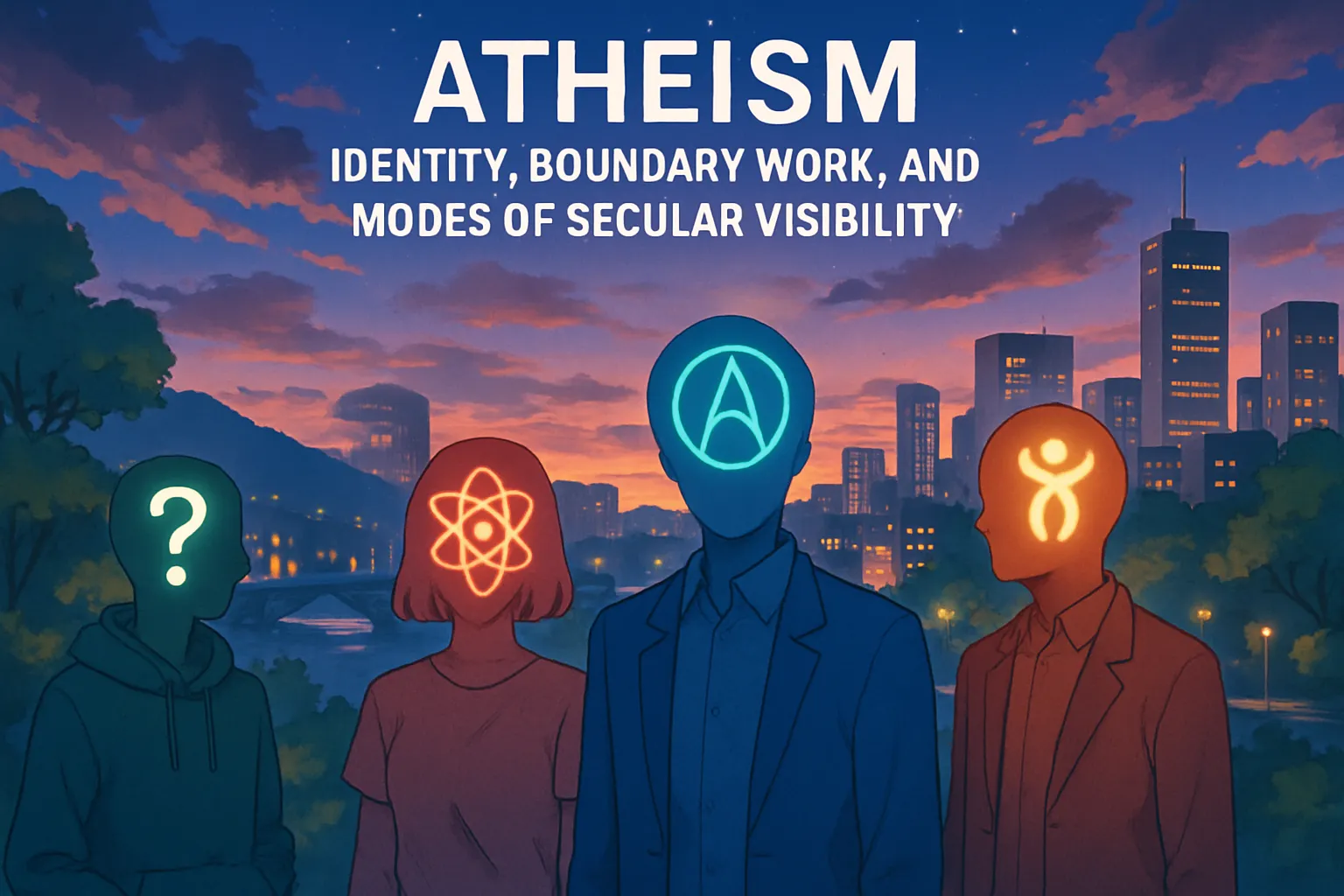
The internal variation in the expression of secular identity—from highly polarized public rants to private indifference—is structured by the level of secular visibility an individual is willing to adopt and the chosen mode of socio-political mobilization (Smith 2018). We can categorize these expressions into three distinct modes:
I. Militant Atheism (The Polemical Mode)
This mode corresponds directly to the adherents and rhetoric of the New Atheism movement (Gartner 2014). It is the most aggressive form of opposition, characterized by explicit political and rhetorical opposition to religious encroachment on secular domains, such as science education and government policy.
Form: Polemical non-fiction, aggressive public debates, and sustained digital activism.
Boundary Work: Maximum negative boundary work, where the distinction between the secular "us" (rational) and the religious "them" (irrational) is drawn as sharply as possible.
Function: This mode often serves a dual purpose: first, as an ideological engine for the movement, and second, as an expression of the conversion narrative often experienced by ex-believers whose moral outrage over religion’s perceived historical and social harms fuels the "them or us" mentality.
II. Pragmatic Secularism (The Strategic Mode)
This mode replaces emotional opposition with intellectual and political strategy, often identified with organized humanist and secular lobbying groups.
Form: Legal advocacy, legislative lobbying, educational outreach, and the organization of non-theistic communities (e.g., secular societies).
Boundary Work: Moderate, principled boundary work. The primary goal is not to eliminate faith, but to achieve a strong wall of separation between church and state, thereby confining religious influence to the private sphere.
Mobilization: Pragmatic secularists are critical of the intentions and broad societal impact of religious subcultures (e.g., in public health or science policy) but seek coexistence defined by civil tolerance. This group frequently critiques Militant Atheism, arguing that hostility generates unnecessary stigma ("the angry atheist" stereotype) which undermines the goal of social acceptance and political efficacy. Their contentious priority is demonstrating that secularity and moral reasoning are compatible, making them the active, organizational backbone of the wider atheist movement.
III. Apathetic/Private Nonreligion (The Passive Mode)
This category represents the non-mobilized majority, often statistically captured as "Nones" who hold no religious belief but do not actively embrace the public atheist label (Hout & Fischer 2014). This mode is defined by zero political mobilization; identity is purely a private conviction.
Apathetic Nonbeliever: Non-visible due to genuine indifference. They have successfully secularized their lives to the point where religious claims lack relevance, indicating a high degree of personal secularization.
Closeted Atheist: Non-visible due to fear of negative social sanctions (ostracization, familial breakdown) from religious cohorts. This group is acutely aware of the oppositional context but chooses non-participation as a form of self-preservation, demonstrating the real-world risk associated with public visibility.
The Networked Secular Community
The atheist community functions as a stationary diaspora, reliant on digital platforms for cohesion (Campbell & Tanton 2012). The internet has transformed atheist organization from a historical unidirectional model (writer/podcaster to passive listener/reader) into a vibrant, networked community. Platforms that facilitate internal discourse (social networking sites for non-theists) allow the community to negotiate its identity and transition the newly "un-closeted" from the aggressive fervor of Militant Atheism toward the more sustainable Pragmatic Secularism.
While radical individualism has been historically characteristic of secular persons, the continued threat of religious imposition acts as a centralizing force. This shared external opposition ensures that, despite internal ideological variation, the negation of theism remains the fundamental element holding the community together and sustaining its organizational efforts.
Conclusion
Atheism, as an active identity, is a complex constellation of secular visibility framed by the necessity of negative boundary work. This paper’s contribution lies in the delineation of the three modes—Militant, Pragmatic, and Apathetic/Private—which successfully map the distance between private conviction and public, organized opposition. The militant mode establishes the boundary, the pragmatic mode works to institutionalize secular policies within that boundary, and the apathetic/private mode measures the success of secularization within personal life. Ultimately, the choice of an atheist mode reflects a calculated decision regarding the risk and necessity of public opposition. Further empirical research should employ this three-mode spectrum to analyze cross-cultural variations, examining how the level of religious institutional power directly correlates with the intensity and ratio of Militant versus Pragmatic secular mobilization.
Works Cited (Placeholder List)
Campbell, H., & Tanton, R. (2012). Religion and the Internet: Critical Approaches to Religious Online Activity. Continuum.
Dawkins, R. (2006). The God Delusion. Bantam Books.
Gartner, J. (2014). "The Sociology of New Atheism." Journal of Contemporary Religion.
Hout, M., & Fischer, C. S. (2014). "Religious change in the US." Demography.
Lamont, M., & Molnár, V. (2002). "The Study of Boundaries in the Social Sciences." Annual Review of Sociology.
Putnam, R. D. (2011). American Grace: How Religion Divides and Unites Us. Simon & Schuster.
Smith, C. (2018). Secularism and the Public Square: Identity and Visibility. Oxford University Press.
Comments
Post a Comment