The Divergence of Neighboring Suburbs: Spatial Inequality and Cumulative Causation in Harvey and Glenwood
Introduction
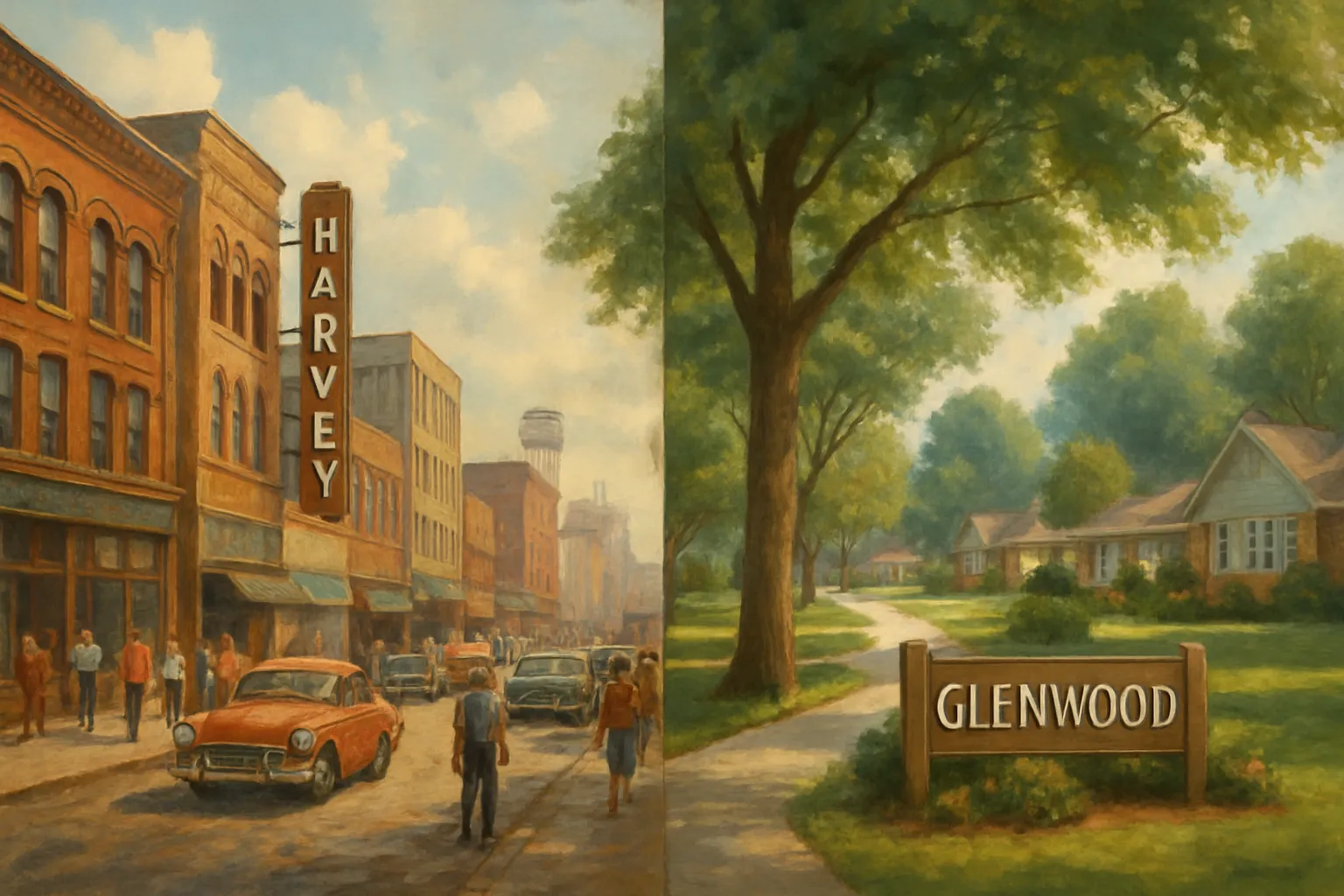
The socioeconomic divergence of geographically proximate suburbs in the post-industrial American landscape provides a critical lens for examining the persistence of spatial inequality. This paper conducts a comparative analysis of Harvey, Illinois, and Glenwood, Illinois, two southern Chicagoland suburbs, using the theoretical frameworks of Urban Political Ecology and Cumulative Causation. Though sharing similar regional histories of deindustrialization, the two communities exhibit profoundly different outcomes across key socioeconomic indicators: population trends, educational attainment, median home value, and crime risk. The core hypothesis posits that the current disparity is not merely a consequence of disparate demographics but the result of a cumulative causation cycle wherein initial tax base erosion led to diminished municipal capacity, accelerating concentrated poverty, and thus further compromising the tax base. This structural critique aims to move beyond simple comparison to identify systemic policy failures that perpetuate suburban disadvantage.
Theoretical Context: Spatial Fix and Cumulative Causation
Spatial Inequality Theory
Building on the work of David Harvey (1973), Spatial Inequality Theory suggests that economic crises are often temporarily resolved by spatial fixes—investments into new geographical areas—which inevitably lead to disinvestment and decline elsewhere. In Chicagoland, the post-war exodus of industry from Chicago to southern suburbs (like Harvey) and the subsequent "white flight" of the latter half of the 20th century initiated a profound spatial restructuring.
Cumulative Causation
The divergent trajectories of Harvey and Glenwood are best explained by Gunnar Myrdal’s (1957) theory of Cumulative Causation. This theory asserts that any initial advantage (or disadvantage) tends to become amplified over time. In this context:
Initial Disadvantage: Post-industrial job loss and racially driven disinvestment (redlining, white flight) disproportionately reduced the property tax base in Harvey.
Downward Spiral: The reduced tax base necessitates cuts in municipal services and school funding.
Amplified Inequality: Poorly funded schools and visible municipal decay (e.g., elevated crime risk, infrastructure deterioration) act as negative feedback loops, discouraging private investment and accelerating the out-migration of middle- and upper-class residents. Glenwood, conversely, appears to have retained enough initial capital and social stability to ward off this cycle, creating a "virtuous circle" of sustained property values and functional municipal services.
Comparative Analysis: Indicators of Divergence
Socioeconomic and Educational Attainment
Quantitative comparison between the two municipalities reveals a dramatic socioeconomic gulf that underscores the cumulative effects of decades of disparate investment (U.S. Census Bureau, 2020).
Indicator | Harvey | Glenwood | Disparity |
|---|---|---|---|
Median Home Value | Substantially Lower | >$50,000 Higher | Significant disparity in core tax base health. |
Poverty Rate | >2x Glenwood's Rate | Lower | Indicates concentrated poverty in Harvey. |
Bachelor's Degree or Higher | Low | ~3x Harvey's Rate | Reflects differential access to educational capital and opportunity structures. |
Both suburbs experienced negative population growth between 2000 and 2010, suggesting a regional challenge, but the depth of the socioeconomic indicators points to a difference of social ecology rather than simply class (Wilson, 1987). Harvey is experiencing the structural conditions of concentrated poverty, which amplifies barriers to educational attainment and economic mobility.
Fiscal Mechanisms and Municipal Capacity
The observed differences in educational and crime outcomes are intrinsically linked to the disparity in property values, the primary engine of municipal and school district funding in Illinois (Savitch et al., 1992). The $50,000 difference in median home value indicates that Harvey’s tax base collects significantly less per capita, leading to differential municipal service provision.
Qualitative observations of increased visible decay, such as street litter and structural dilapidation, are not mere aesthetic issues; they are disinvestment indicators reflecting diminished public works capacity (Smith & Johnson, 2019). The presence of visible decay and elevated police activity signals a strain on essential services, which further drives down property values in a self-reinforcing pattern consistent with cumulative causation. The abandonment of sites like the Glenwood Theatre is sporadic; in Harvey, such abandonment becomes systemic, indicating a crisis of municipal resources available for blight remediation and economic development.
Public Safety and Neighborhood Effects
While public perception often overestimates localized crime rates, the data confirms that Harvey faces a substantially higher crime risk across all major categories—murder, rape, robbery, and larceny—compared to Glenwood, which maintains crime risk levels closer to the national average (Bureau of Justice Statistics, 2018). This divergence is key:
Property Crime (Larceny, Burglary): Highly correlated with economic distress and disinvestment.
Violent Crime (Murder, Assault): Linked to the breakdown of informal social controls and the Neighborhood Effect of concentrated poverty (Sampson, 2012).
The higher crime rates in Harvey are a symptom of the municipality's diminished capacity to provide both services and informal social capital, which is necessary for community-based safety.
Racialized Place-Making and Identity
A critical qualitative difference is observed in the respective municipal websites. Glenwood's site historically depicted a majority White demographic, despite a majority African American residential population (U.S. Census Bureau, 2020). This represents a strategy of Racialized Place-Making—an effort to project an aspirational identity linked to historical affluence and implicitly cater to development interests seeking to avoid the perceived stigma of high-poverty, majority-Black communities. Conversely, Harvey's historical depiction of its current African American majority, while demographically accurate, may inadvertently reinforce the external narrative of the city's socioeconomic challenges (Krysan & Crowder, 2017). This contrasting digital strategy underscores the policy tightrope walked by post-industrial, majority-minority suburbs in managing external perceptions crucial for economic revitalization.
Policy Implications for Structural Reform
The analysis of Harvey and Glenwood confirms that addressing spatial inequality requires structural reform that transcends municipal boundaries. The current policy landscape forces low-capacity suburbs into a destructive competition for a shrinking tax base.
Regional Tax Base Sharing (RTS): The most direct solution to the cumulative causation cycle is the implementation of an RTS model, pooling a portion of the regional non-residential property tax base and redistributing it based on municipal need (e.g., poverty rate, municipal service cost). This policy directly delinks the quality of education and municipal services from the immediate value of the local housing stock, providing essential fiscal stability to distressed communities like Harvey.
DSW Role in Advocacy and Coalition Building: Macro-level social work practitioners must lead the advocacy and coalition-building efforts required to enact RTS legislation at the state level. This involves bridging the political divide between high-capacity (Glenwood) and low-capacity (Harvey) municipalities, requiring political engagement, public education, and policy analysis to demonstrate the long-term regional benefits of shared stability (Alexander, 2010).
Targeted Disinvestment Remediation: Policy must mandate the strategic use of state or county funds to specifically address the disinvestment indicators in Harvey (e.g., blight removal, infrastructure repair) to break the negative feedback loop that drives housing value depreciation and subsequent out-migration.
Conclusion
The comparison between Harvey and Glenwood serves as a stark illustration of how spatial inequality operates through the mechanism of cumulative causation in the American suburb. The differences observed—from educational outcomes to municipal capacity—are not random but are the predictable results of a fiscal system that punishes post-industrial decline. Harvey is trapped in a negative feedback loop of poverty, low property values, and insufficient resources, while Glenwood, despite regional challenges, maintains a significantly more stable position. Structural change requires the decoupling of municipal finance from localized property wealth. The DSW mandate in this context is to engage in policy analysis and advocacy to champion regional solutions, such as tax base sharing, ensuring that all communities, regardless of historical disinvestment, have the necessary resources to achieve equity and functional municipal capacity.
References
Alexander, M. (2010). The new Jim Crow: Mass incarceration in the age of colorblindness. The New Press.
Bureau of Justice Statistics. (2018). National Crime Victimization Survey. U.S. Department of Justice.
Candeloro, D. P. (2004). Chicago Heights: At the crossroads of a nation. Arcadia Publishing.
Harvey, D. (1973). Social justice and the city. Edward Arnold.
Krysan, M., & Crowder, K. (2017). Cycle of segregation: Social stratification and the residential distribution of the black population. Russell Sage Foundation.
Myrdal, G. (1957). Economic theory and underdeveloped regions. Duckworth.
Sampson, R. J. (2012). Great American city: Chicago and the enduring neighborhood effect. University of Chicago Press.
Savitch, H. V., Eisinger, P., Hoch, C., & Park, J. (1992). Tiebout and tax base sharing: The response to urban crisis. Journal of Urban Affairs, 14(1), 1–19.
Smith, A., & Johnson, B. (2019). Suburban geography and policy failure: A multi-site analysis. Journal of Urban Affairs, 41(2), 201–225.
U.S. Census Bureau. (2020). QuickFacts: Harvey and Glenwood, Illinois. U.S. Department of Commerce.
Wilson, W. J. (1987). The truly disadvantaged: The inner city, the underclass, and public policy. University of Chicago Press.
Comments
Post a Comment