Introduction: Institutional Creep and the Perforation of the Jeffersonian Wall
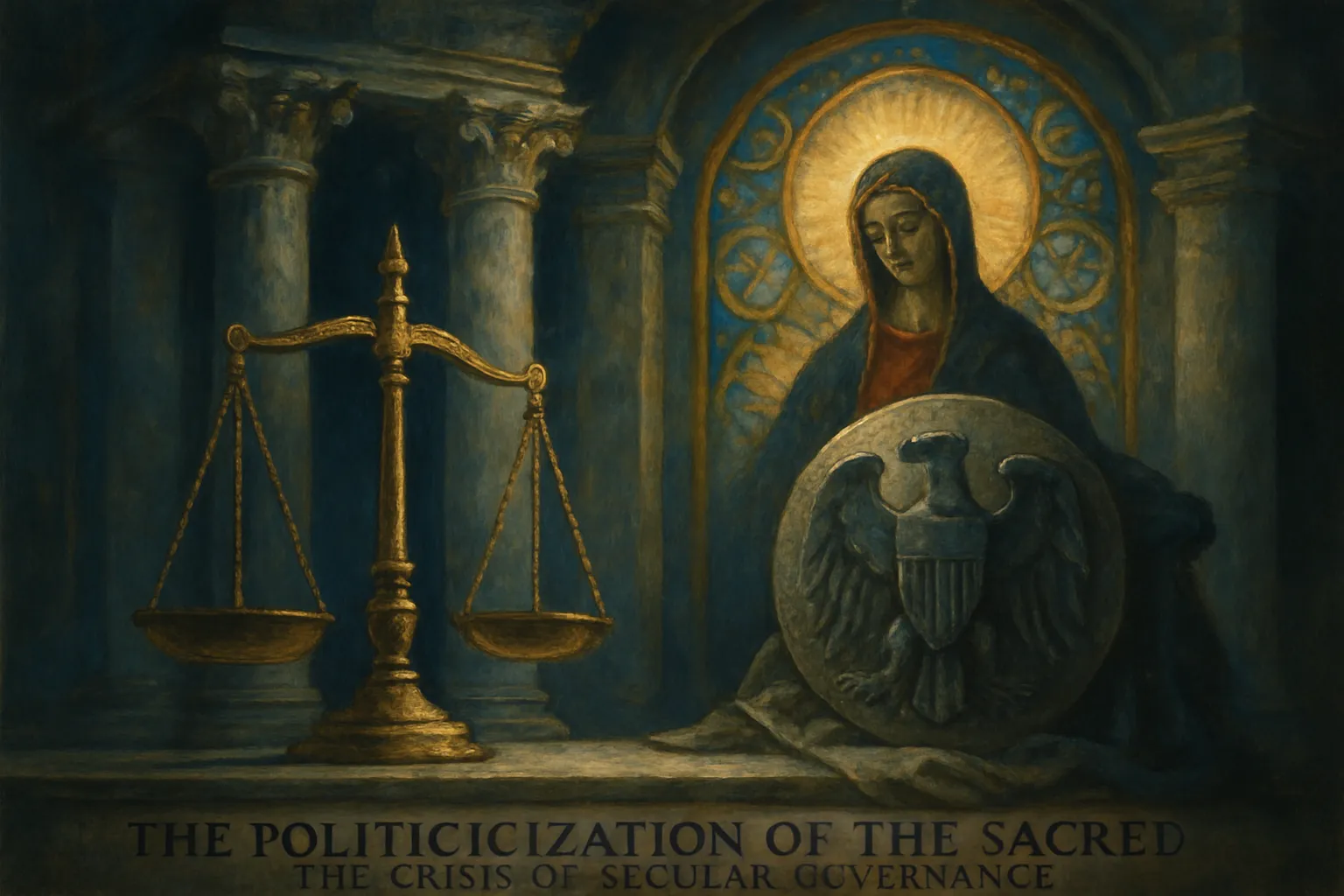
The American political system requires a renewed focus on the functional integrity of institutional secularism. This paper argues that the persistent encroachment of religious symbolism and ideology into the public sphere—a process termed institutional creep—constitutes a systemic threat to the constitutional legitimacy and civic unity of the state. Far from a benign expression of individual piety, this creep represents a deliberate strategy designed to functionally perforate the Jeffersonian "wall of separation," thereby establishing a de facto political theology within the framework of a secular government.
The political right has strategically codified "cultural values" as the ideological nexus for its mobilization. As Taylor (2007) observes, these values are intrinsically rooted in temporal politics, prioritizing an idealized, often fictitious past over the imperatives of the future. The conservative focus on issues like family structure, reproductive autonomy, and evolutionary theory is not merely a moral debate but a struggle to impose a static, historically specific definition of the body politic. In an accelerating context of social and technological change, the perceived certainty of this mythologized past becomes a powerful, reactionary counter-force against unavoidable, pluralistic modernity.
I. Constitutional Consistency and the Endorsement Test
The persistent inconsistency between the constitutional mandate of the Establishment Clause and the widespread practice of state-sanctioned religious symbolism generates a profound crisis of legal legitimacy. The legislative insertion of theistic references (such as "In God We Trust" on currency and "under God" in the Pledge of Allegiance) represents a direct contradiction to the anti-establishment principles articulated in the First Amendment.
To address this, the enforcement mechanism must rely on a rigorous legal standard. We advocate for the Endorsement Test, which requires that state action must not have the purpose or effect of endorsing or disapproving of religion in the eyes of a reasonable observer. This is critical because the challenge is not merely legal, but epistemological: the citizenry, subjected to decades of state-sponsored religious symbolism embedded in civic rituals and economic instruments, internalizes these insertions as normative or even foundational. This normalization dulls public perception, enabling the judiciary to utilize the flawed doctrine of Ceremonial Deism (as seen in cases like Lynch v. Donnelly). This doctrine incorrectly views state-sponsored religious acts as historically acceptable civic customs, rather than as functional acts of establishment that fail the test of neutrality. What is required is not a legislative revision, but a re-invigoration of strict neutral enforcement, serving as a necessary heuristic to reorient the polity toward its secular legal foundations.
II. The Necessary Secular Mechanism: Lessons from Abolition
The 19th-century debate over abolition provides a critical historical precedent demonstrating the ultimate necessity of secular constitutionalism for resolving intractable political-theological conflicts. As Jacoby (2004) meticulously documents, both pro- and anti-slavery factions utilized Biblical scripture to assert the ultimate authority of their moral claims regarding the definition of political ontology—the legal and social definition of human personhood endowed with rights.
Crucially, the conflict was fueled by religious moral mobilization (e.g., the Second Great Awakening and abolitionist Christian theology), which supplied the moral imperative. However, the resolution of the conflict was achieved not through theological consensus, but through the secular political mechanism of constitutional amendment (the 13th, 14th, and 15th Amendments) and legislative fiat. By formally redefining "human" and "citizen" within the legal and political apparatus, the state provided a neutral, secular ground upon which consensus could be built, ultimately transcending the binary, non-negotiable claims of competing religious hermeneutics. This historical resolution affirms that the secular constitutional framework is the necessary precondition for establishing a stable, common set of presuppositions regarding the structure and provision of American governance.
III. State Rituals, Civil Religion, and the Limits of Coercion
The mandatory recital of the Pledge of Allegiance in public schools functions as a primary state ritual designed for civic assimilation, initiating young citizens into the norms of the political community. As scholars of Civil Religion have noted, this shared symbolic system can promote civic unity and national transcendence, providing a non-denominational framework for collective belonging. However, the post-1954 addition of "under God" transforms the purely civic oath into an instrument of coercive establishment.
Jefferson's intent in establishing the wall of separation, as explored by Neem (2007), was precisely to protect free inquiry by preventing a political alliance between religious and governmental authorities. The goal was the preservation of a space where reason, rather than fabricated mysticism, could govern political discourse. The compulsory recitation of a pledge—historically a solemn, legally binding contract of loyalty—by an uncontextualized minor under institutional authority represents a form of state coercion inconsistent with the neutrality principle.
Furthermore, the ubiquitous inscription of "In God We Trust" on currency, the lifeblood of the capitalist nucleolus, functionally elevates an economic transaction to a quasi-religious affirmation. The central political question here is whether such symbolic establishment, even if categorized as Ceremonial Deism, fundamentally alters the nature of state-citizen interaction, or whether Congress can successfully decouple the use of "God" from its religious connotation to successfully bypass the non-establishment mandate without violating the Endorsement Test.
IV. The Institutional Neutrality Boundary: Personnel and Expression
The case of the public high school teacher, Hermant Mehta, illustrates a contemporary legal tension regarding institutional neutrality and the limits of state control over its employees. The attempt by the Illinois Family Institute (IFI) to secure the teacher’s dismissal based on his private, non-theistic advocacy demonstrated a misunderstanding of the fundamental boundaries set by the First Amendment.
The legal boundary is drawn between two clauses: the Establishment Clause, which constrains the state (the teacher acting in their official capacity) from establishing religion, and the Free Exercise/Free Speech Clauses, which protect the individual citizen (the teacher in their private capacity) from state censorship. The IFI sought to weaponize the Establishment Clause as a tool of private ideological censorship, effectively trying to extend state-imposed neutrality into the private lives of secular citizens (Mehta, 2009). This case underscores the core requirement that institutional neutrality must be maintained by the state in its official capacity, but must never be used to suppress the private, non-governmental expression of individuals, regardless of their religious or non-religious viewpoint.
V. The Foundational Crisis: Popular Sovereignty vs. Political Theology
Arguments asserting the Christian origin of the United States often fail to grasp the political-theological discontinuity introduced by the Founders. While the population was overwhelmingly Christian, the Constitution is explicitly secular. Its authority is not derived from a divine right—the very political model the Founders sought to escape following their experience with British theocracy—but is solely derived from popular sovereignty.
The Establishment Clause and the No Religious Test Clause (Article VI) are structural provisions designed to ensure that political authority is created, maintained, and executed exclusively by the people, insulating the nascent republic from the historical tyranny of theological governance. The contemporary interpretation, which posits that the wall of separation protects religious practice from the state but does not restrict religious expression in the political sphere, fundamentally inverts the Founder's original intent. This trend treats secularization as an effective limitation on religious freedom, arguing that if religion cannot manifest through state mechanisms (like the Pledge or coinage), its political expression is unjustly capped. Such inserts, however, are not exercises of individual freedom; they are acts of the state that in a strict sense, are unconstitutional as they fail the core test of non-endorsement (Sullivan, 2009). The existing constitutional text is sufficient; the enforcement mechanism requires re-invigoration.
Conclusion: The Imperative of Institutional Neutrality
The analysis confirms that the challenges to constitutional secularism stem from a deliberate political strategy of institutional creep and a widespread failure to rigorously apply the principle of government neutrality. The continued acceptance of Ceremonial Deism perpetuates a state of affairs where the government is perceived as endorsing majoritarian religious belief, thereby undermining the democratic commitment to a genuinely pluralistic public sphere.
American secularism fundamentally represents the rejection of establishment as a political method, allowing religious expression through all other avenues. The challenge for the polity is to articulate and defend the constitutional principle of neutrality not as an anti-religious doctrine, but as the only viable mechanism for preserving a genuinely democratic state structure whose legitimacy rests on the collective will of all its citizens, regardless of their ultimate beliefs. Upholding institutional neutrality is the necessary political-theoretical imperative for maintaining the integrity of a state governed by reason and popular sovereignty.
References
Jacoby, S. (2004). Freethinkers: A history of American secularism. Metropolitan Books.
Mehta, H. (2009). Why the Illinois Family Institute Is Angry With Me. The Friendly Atheist.
Neem, J. N. (2007). Beyond the wall: Reinterpreting Jefferson's Danbury Address. Journal of the Early Republic, 27(1), 139–154.
Sullivan, W. F. (2009). We are all religious now. Again. Social Research, 76(4), 1181–1198.
Taylor, M. C. (2007). After God. The University of Chicago Press.
Comments
Post a Comment