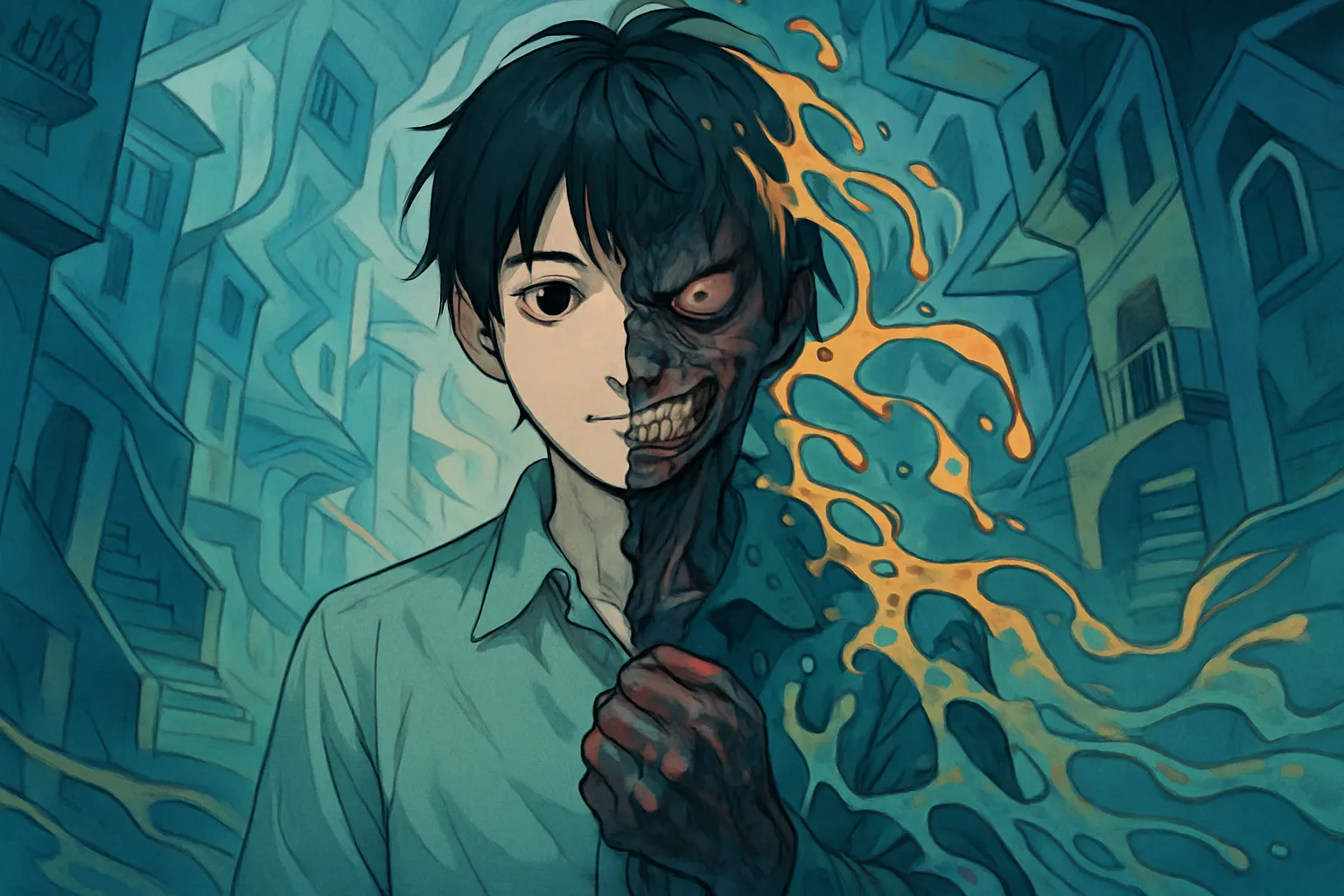
The scar is not a memory; it is a functioning machine that demands a new set of inputs.
To speak of Juzo is to speak of a ruptured flow, a primary production of desire that has been intercepted by a corrosive event. In Neighbor No. 13, the acid poured onto a child’s face is not merely a cinematic trope of trauma; it is a literal and symbolic deterritorialization of the face-system. The face, as Deleuze and Guattari (1987) suggest, is a "white wall/black hole" system of social signifyin'—it is the territory upon which the State and the School map the "human." When the acid hits, the territory is dissolved. Juzo is left with a Body-without-Organs (BwO) that refuses to settle, a raw surface of intensity that can no longer sustain the molar identity of the "good student" or the "docile citizen."
The cabin in the woods is an engine room
We open not in a classroom, but in the intensive depth of the psyche-factory. The dark cabin where the young, naked, crying Juzo is held captive by his own shadow is the primary site of stratification. This is the "schizophrenic out for a walk" who has been tripped and locked in a shed. The splitting of the ego depicted in the film—the emergence of No. 13—is not a "mental illness" in the traditional, clinical sense, but a "line of flight" that has turned into a line of destruction. As the violent alter-ego drags the traumatized child over the threshold, we witness the birth of a desiring-machine that has learned to produce only through the negation of the other.
This internal struggle is the molecular reality of what the DSM-V calls C-PTSD. But schizoanalysis asks: what does this trauma do? It stops being a "history" and starts being a "circuit." The cabin is a part of the machine. The beating is a part of the machine. The threshold is the moment where the private intensity of pain is translated into the public extension of revenge. Nietzsche (1887/1967) understood this as the ressentiment of the slave, but Juzo complicates this; he is not just a slave seeking a new master, he is a subject trying to "un-become" the victim by becoming the storm.
Why the bystanders are actually ghost-machines
The classroom scene where bullies pray over Juzo’s desk as if at a funeral is a masterpiece of fascist micro-politics. Why do the other children flee? Why does the majority, the "social body," dissolve into a mist of giggles and exits? It is because the education system is a "molar apparatus" designed to produce individualism at the expense of solidarity. As Foucault (1975/1977) observed, the school is a "machinery of control" that partitions individuals, ensuring they are always visible to power but invisible to one another.
"The school serves as a secondary apparatus of capture, where the wild flows of childhood are channeled into the narrow gutters of competition and rank. In this space, the bully is not a glitch in the system; he is the system's most honest expression of hierarchy." (Deleuze & Guattari, 1972/1983, p. 210).
The bystanders are not "scared" in a vacuum; they are "trained into fear." They have been taught that to intervene is to cross a boundary of the "self" that the school has spent years fortifying. Their flight is a "territorial retreat." They leave the room because their empathy has been "coded out" of them by a curriculum that rewards the "isolated achiever." The "autocratic nature" of the teacher-student relationship is mirrored in the bully-target relationship. Both require a submissive subject and a silent audience.
The gendered architecture of the "Suck it up" machine
Boys are taught to experience pain as a silent accumulation of capital. "Suck it up." "Walk it off." These phrases are the "command-posts" of a linguistic machine that demands the suppression of the molecular. To show pain is to "deterritorialize" the masculine identity, to become "feminine," "weak," "other." Juzo’s response—the creation of No. 13—is an attempt to satisfy the masculine requirement of "aggression" while keeping the "vulnerable" Juzo hidden in the dark cabin of the unconscious.
But No. 13 is not a "cure." He is a "paranoiac-fascist" response to a "schizo-traumatic" event. Reich (1933/1970) identified this in the "character armor" of the individual: the body itself becomes a fortress, hardening against the world to prevent further penetration by trauma. Juzo’s face is scarred, but his soul is armored. The acid didn't just burn skin; it "welded the ego" into a static position of revenge.
Neighboring the abyss
When Juzo moves in next door to his childhood tormentor, Akai, he is not just seeking a physical proximity; he is seeking a "re-coding of the past." He wants to turn the "humiliation-event" into a "mastery-event." But the schizoanalytic perspective warns us that revenge is often just another way of being "captured" by the enemy. By focusing his entire life-flow on Akai, Juzo remains "territorialized" on the bully. He is still a "satellite of the acid-bottle."
"Revenge is the ultimate trap of the molar identity; it seeks to balance a scale that was never meant to be measured, binding the subject to the very ghost they wish to exorcise." (Baudrillard, 1981/1994, p. 54).
The film’s slick, almost hyper-real aesthetic serves to highlight this "simulacrum of closure." Juzo thinks he is becoming a "man" by becoming a "killer," but he is actually just becoming a "mirror." The violence in Neighbor No. 13 is a "feedback loop." It is the sound of a machine that has forgotten its original purpose and now only knows how to "overheat."
Final thoughts on the molecular massacre
The youth of today—represented here by the ghosts of Juzo’s past—are caught in a "war machine" that has no front line. The bullying is systemic because the society is systemic. We cannot fix the "bully" without dismantling the "classroom," and we cannot fix the "target" without dismantling the "family." Juzo’s tragedy is that he tried to "solve" a political problem (oppression) with a psychological solution (dissociation).
In the end, No. 13 is the "dark double" of the State. He is the one who "takes care of business" when the Law fails. But as long as the cabin remains in the woods, as long as the child remains naked and crying in the dark, the "acid" continues to pour. The only way out is a "radical deterritorialization"—a refusal to be either the bully or the target, a "becoming-revolutionary" that burns down the cabin and the classroom alike.
References
Baudrillard, J. (1994). Simulacra and simulation (S. F. Glaser, Trans.). University of Michigan Press. (Original work published 1981)
Deleuze, G., & Guattari, F. (1983). Anti-Oedipus: Capitalism and schizophrenia (R. Hurley, M. Seem, & H. R. Lane, Trans.). University of Minnesota Press. (Original work published 1972)
Deleuze, G., & Guattari, F. (1987). A thousand plateaus: Capitalism and schizophrenia (B. Massumi, Trans.). University of Minnesota Press. (Original work published 1980)
Foucault, M. (1977). Discipline and punish: The birth of the prison (A. Sheridan, Trans.). Pantheon. (Original work published 1975)
Inoue, Y. (Director). (2005). Neighbor No. 13 [Film]. Amuse Soft Entertainment.
Nietzsche, F. (1967). On the genealogy of morals (W. Kaufmann & R. J. Hollingdale, Trans.). Vintage Books. (Original work published 1887)
Reich, W. (1970). The mass psychology of fascism (V. R. Carfagno, Trans.). Farrar, Straus and Giroux. (Original work published 1933)
Comments
Post a Comment