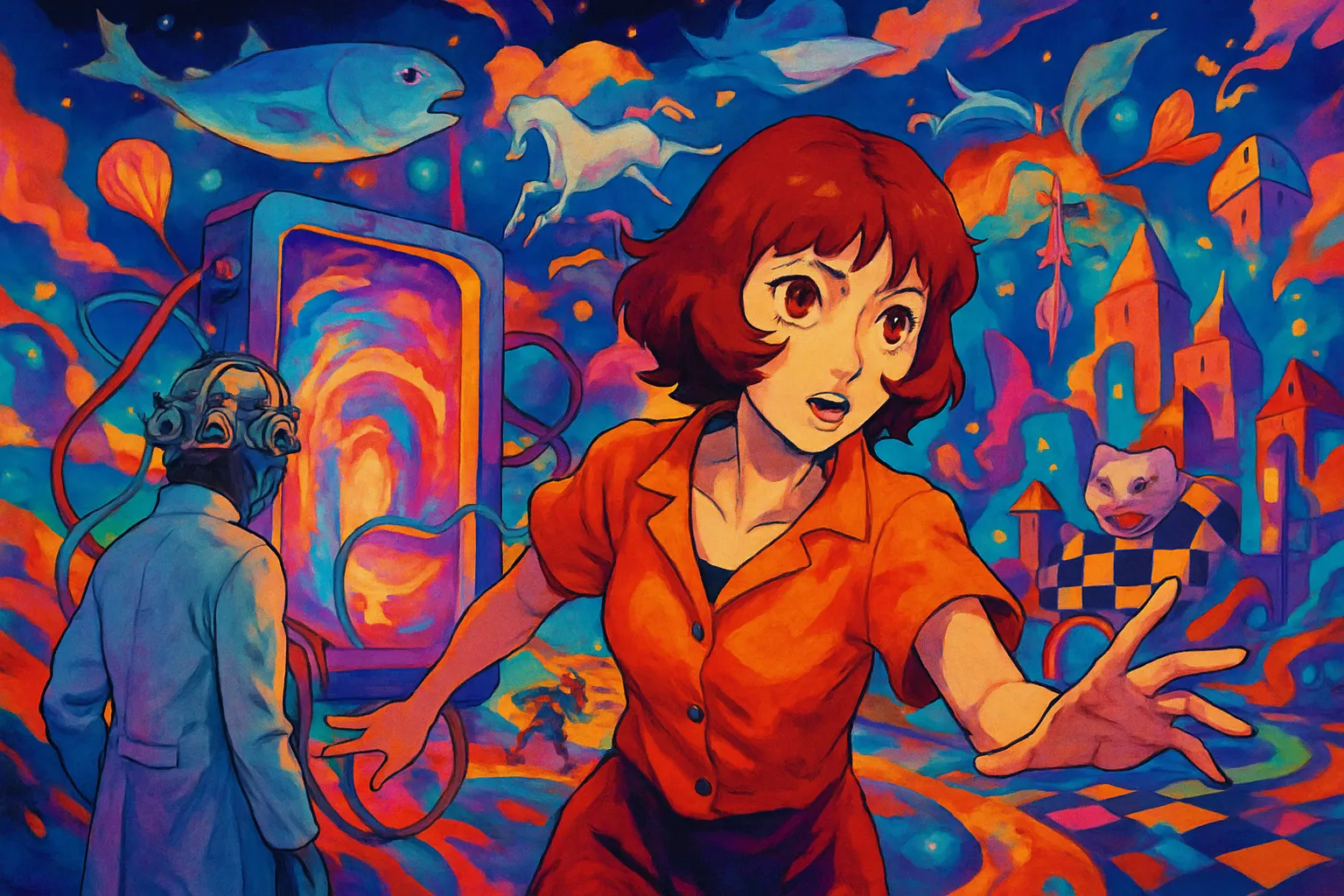
The sidewalk is a fever dream and the therapist is a ghost
We have spent the better part of a century pretending that the pillow is a barricade, a silent border patrol guarding the sovereignty of the waking ego against the nocturnal factory of the id. But the dream is not a theater of representation; it is a laboratory of production, a desiring-machine that refuses to punch a clock. Freud (1900/1953) famously attempted to domesticate this factory, framing the dream as a "wish fulfillment" that functions as a safety valve for the psyche—a way to keep us asleep by processing the cereal boxes and the naval anxieties into a manageable narrative. Yet, in the hallucinatory sprawl of Satoshi Kon’s Paprika, the barrier does not merely leak; it undergoes a total molecular deterritorialization. The dream is no longer a private cinema for the individual neurotic; it has become a public flow, a nomadic intensity that threatens to drown the social field in a parade of refrigerators and Japanese dolls.
When the dream is externalized, recorded, and viewed as a third-party artifact, the very architecture of psychoanalysis begins to crumble. The traditional "couch" is a static apparatus designed to contain the flow, but what happens when the analysand and the analyst are both sucked into the screen? The dislocation of the dream perspective—from the "I" who dreams to the "Eye" who watches—creates a schizoid fracture in the subject. The therapist is no longer an interpreter but a co-conspirator in a shared psychosis. In this state, the "meaning" of the clown with the maggot-teeth is irrelevant; what matters is the connection—the way the maggot-machine plugs into the dental-anxiety-machine to produce a new, terrifying intensity.
The carnival of partial objects
The film presents a slippage of associations where reality is not "broken" but revealed as a series of stratified layers that have lost their adhesive. Chiba, the avatar of scientific rationality, finds herself hopping a small fence in a dream carnival, only to realize as she scales it that the "fence" is the railing of a skyscraper in the "real" world. This is the "schizophrenic out for a walk" (Deleuze & Guattari, 1972/1983) materialized as a spatial crisis. The world is no longer a collection of objects with stable identities; it is a series of lines of flight where a toy can become a god and a railing can become a cliff.
"The schizophrenic is not a 'person' at all, but a series of states, a flow of intensities that refuses to be localized in a single ego or a single family history. The walk is the method; the movement is the message" (Deleuze & Guattari, 1972/1983, p. 131).
This "carnival" is the return of the repressed, but not in the way Freud envisioned. It is the "Body-without-Organs" (BwO) of the city itself—a giant, swarming mass of desire that has been uncoupled from the repressive coding of the state and the family. The Chairman, who functions as the molar tyrant of the film, seeks to re-stratify this flow, to colonize the dream-space and turn it into a private monument to his own withered ego. He represents the "death instinct" as a form of total order, a desire to stop the movement-image and replace it with a static, eternal gaze. Against him, Paprika is the "becoming-woman," the "becoming-molecular" (Deleuze & Guattari, 1980/1987) that refuses to be captured by the Chairman’s surveillance.
Detective Konakawa and the cinema of guilt
The most poignant line of flight in the film belongs to Detective Toshimi Konakawa. His "trauma" is not a hidden sexual secret but an unfinished film—a literal failure of production. He is haunted by the image of a chase scene where he, the young filmmaker, pursues a suspect who is also his own co-director, his own ideal, his own lost "becoming." For years, this "unfinished movie" has acted as a blockage, a knot in his desiring-production that has curdled into guilt. He became a "real" cop as a way to mourn the friend who died, trading the creative flux of the cinema for the repressive apparatus of the law.
However, the resolution Konakawa achieves is not a traditional "catharsis." He does not "recover" a lost memory; he re-narrates his existence. He realizes that by becoming a detective, he did not abandon the film—he finished it in the medium of reality. He was the detective chasing the suspect all along. This is the Nietzschean "Great Noon," the moment where the subject stops looking backward at the "thou shalt" of the past and says "I will" to the present (Nietzsche, 1883/2006).
"To redeem what is past, and to transform every 'It was' into 'Thus would I have it!'—that alone do I call redemption!" (Nietzsche, 1883/2006, p. 110).
Konakawa’s "leap of faith" is a schizoanalytic move: he breaks the "Oedipal" guilt—the feeling that he failed the father/friend figure—and accepts his life as a completed work of art. He recognizes that there is no "correct" interpretation of his life, only a choice between competing narrations. By choosing the one that allows him to "enjoy his life," he performs an act of radical existential freedom. He stops being a victim of his history and starts being the editor of his own movement-image.
The simulacrum swallows the sun
As the film reaches its crescendo, the distinction between the dream and the waking world is not merely blurred; it is annihilated. This is the "precession of simulacra" (Baudrillard, 1981/1994), where the map (the dream) precedes the territory (the world) and ultimately generates it. The characters are no longer "people" in a city; they are images in a sequence. The "Great Parade" is the ultimate expression of the "political economy of desire"—a massive, uncoordinated production of junk, deities, and technology that marches across the screen of the world.
"The simulacrum is never that which conceals the truth—it is the truth which conceals that there is none. The simulacrum is true" (Baudrillard, 1981/1994, p. 1).
The "psychosis" that infests the characters is the realization that the "real" was always a construction, a fragile arrangement of pixels and social codes. Chiba’s struggle to remain "rational" is a struggle to maintain the "molar" subject—the serious scientist, the controlled adult. But Paprika, the "schizo" avatar, knows that the only way to defeat the Chairman’s totalizing dream is to grow bigger than it. Paprika swallows the darkness not by "cleansing" it, but by incorporating it. She becomes a giant, a "maternal" BwO that absorbs the tyrant’s desire and turns it back into the flow of life.
Final cut: The movie is always beginning
The film ends with Konakawa walking into a cinema to see a movie called Dreaming Kids. This is the final "leap." He is no longer afraid of the image; he is no longer haunted by the "unfinished." He has accepted that life is a series of fragmented takes, a "montage of attractions" (Eisenstein) that does not need a final, transcendental Meaning.
The lesson of Paprika is that we are all "dreaming kids" caught in the machinery of a global unconscious. We are telling stories to ourselves at night, and during the day, we are acting them out on the streets. The "cure" is not to wake up—for there is no "outside" to the dream of the social—but to become better directors. We must learn to navigate the slippage of associations without falling off the building. We must learn to hop the fence, even when we know it is a railing.
In the end, Konakawa’s "existential leap" is the only valid response to the schizo-reality of the 21st century. We lay the possible narrations of our lives out on the table—the failure, the success, the cop, the artist—and we choose the one that lets us breathe. We buy a ticket, we sit in the dark, and we watch the parade go by, knowing that we are both the audience and the stars of the show.
References
Badiou, A. (2005). Being and event (O. Feltham, Trans.). Continuum. (Original work published 1988)
Baudrillard, J. (1994). Simulacra and simulation (S. F. Glaser, Trans.). University of Michigan Press. (Original work published 1981)
Deleuze, G. (1986). Cinema 1: The movement-image (H. Tomlinson & B. Habberjam, Trans.). University of Minnesota Press. (Original work published 1983)
Deleuze, G., & Guattari, F. (1983). Anti-Oedipus: Capitalism and schizophrenia (R. Hurley, M. Seem, & H. R. Lane, Trans.). University of Minnesota Press. (Original work published 1972)
Deleuze, G., & Guattari, F. (1987). A thousand plateaus: Capitalism and schizophrenia (B. Massumi, Trans.). University of Minnesota Press. (Original work published 1980)
Foucault, M. (1977). Discipline and punish: The birth of the prison (A. Sheridan, Trans.). Pantheon. (Original work published 1975)
Freud, S. (1953). The interpretation of dreams. In J. Strachey (Ed. & Trans.), The standard edition of the complete psychological works of Sigmund Freud (Vols. 4-5). Hogarth Press. (Original work published 1900)
Kant, I. (1998). Critique of pure reason (P. Guyer & A. W. Wood, Eds. & Trans.). Cambridge University Press. (Original work published 1781)
Kon, S. (Director). (2006). Paprika [Film]. Madhouse.
Lacan, J. (2006). Écrits: The first complete edition in English (B. Fink, Trans.). W. W. Norton & Company. (Original work published 1966)
Marx, K. (1976). Capital: A critique of political economy (Vol. 1) (B. Fowkes, Trans.). Penguin Books. (Original work published 1867)
Nietzsche, F. (2006). Thus spoke Zarathustra (A. Del Caro, Trans.). Cambridge University Press. (Original work published 1883-1885)
Reich, W. (1970). The mass psychology of fascism (V. R. Carfagno, Trans.). Farrar, Straus and Giroux. (Original work published 1933)
Sartre, J. P. (2007). Existentialism is a humanism (C. Macomber, Trans.). Yale University Press. (Original work published 1946)
Zizek, S. (1991). Looking awry: An introduction to Jacques Lacan through popular culture. MIT Press.
Comments
Post a Comment