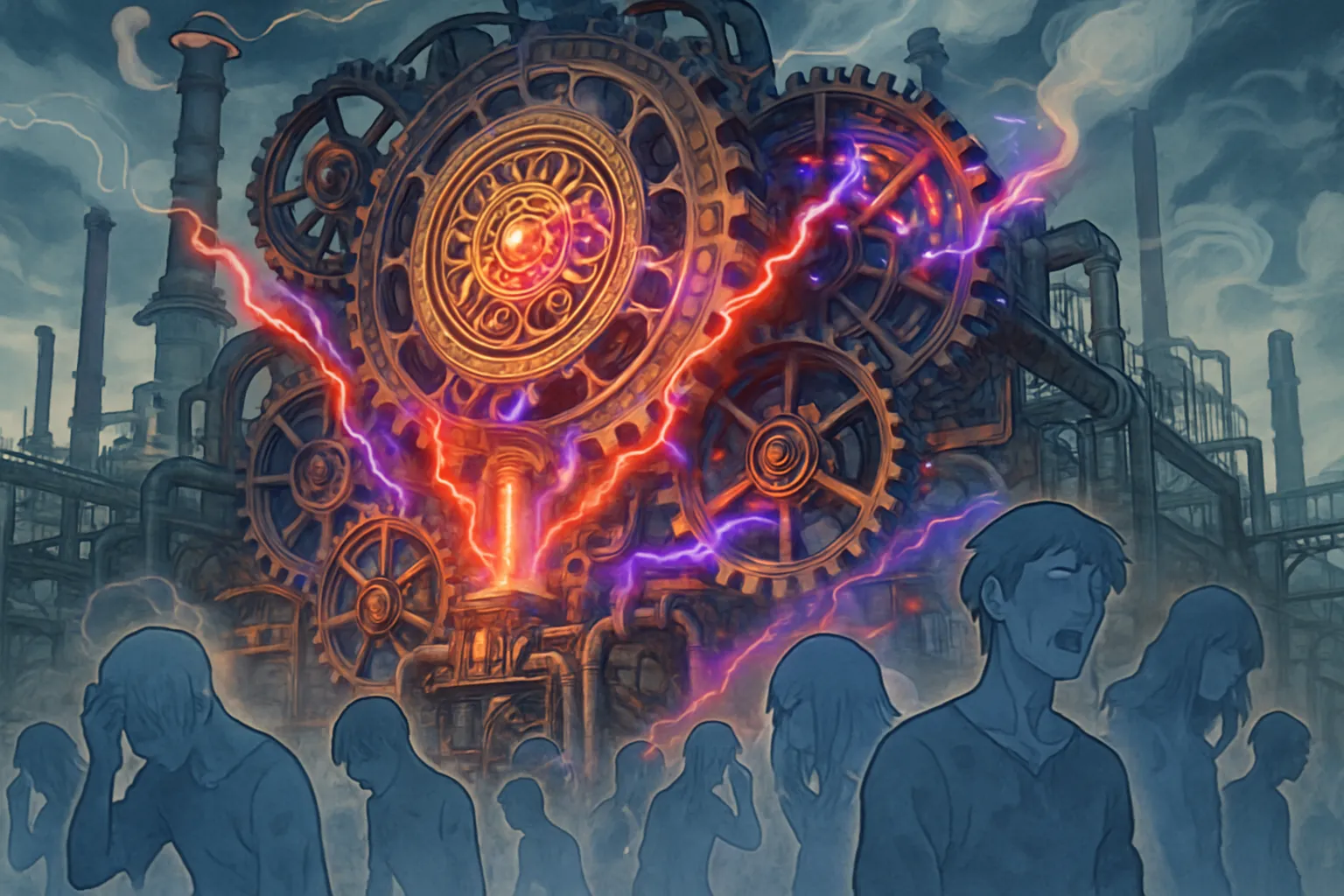
The terrifying realization of the global market is that information does not travel; it colonizes, flattening the jagged peaks of indigenous hauntology into a smooth, digestible paste for the American palate.
The movie within the movie is a liar
We begin with the premise that the soul is not a substance but a circuit. In Takashi Shimizu’s Rinne, the protagonist Nagisa is not a "person" in the liberal-humanist sense, but a junction point for desiring-machines that have refused to cease their grinding. When the first Christian missionaries arrived in Japan, the local response—"Why did you take 2000 years to let us know?"—was not a lament of missed salvation, but a shock at the latency of the signal. Today, that latency is zero. The capitalist lines of production have swarmed the planet, turning every city into a terminal for the same semiotic flows. Yet, this flow is a one-way valve. America exports a rabid, self-destructive individualism—a "Christianity" stripped of its cross and refitted with a bayonet—while importing foreign intensities only after they have been glazed in the sugary film of domestic re-narration. We see this in the systematic suppression of REC in favor of Quarantine; the original must be buried so the copy can simulate life.
Nagisa, an actress seeking a role, finds herself auditioning for her own past. She is a desiring-machine caught in a feedback loop. Reincarnation, in its orthodox bureaucratic form, is a transcendental purification system, a celestial social security office that redistributes karma into new matter. You are processed, weighed, and stamped: baby, goat, grain of sand. It is a caste system of the spirit. But in Rinne, the system malfunctions. The flows are blocked. The ghosts do not want justice; they want the restoration of the circuit.
"Desire is not bolstered by needs, but rather the contrary; needs are derived from desire: they are counterproducts within the real that desire produces" (Deleuze & Guattari, 1972/1983, p. 27).
Nagisa’s desire to be an actress is not a career choice; it is the machine’s attempt to re-assemble the Body-without-Organs (BwO) of the hotel massacre. The hotel is not a place; it is a stratification of time where the murder is perpetually happening. When the director commands the actors to lie down in the exact spots of the corpses, he is not "directing"; he is performing a ritual of deterritorialization, pulling the past into the present through a forced mimicry that collapses the distance between the signifier (the actor) and the signified (the victim).
The super-8 camera is a hungry eye
The film utilizes binaries that function as negations of negations. The doll with bashed-in red eyes is not a toy; it is a partial object, a "break-flow" that captures the gaze of the child. The fictional movie and its real counterpoint are not two separate things but a Möbius strip. As Nagisa’s agent watches the "real" Super-8 murder tape, Nagisa is simultaneously acting out the scene in the studio. This is the "schizophrenic out for a walk"—the dissolution of the academic scaffolding that separates the observer from the observed. The tape is the "real" that Lacan warns us about, the thing that returns to the same place.
"The Real is beyond the automaton, the return, the coming-back, the insistence of the signs, by which we see ourselves governed by the pleasure principle" (Lacan, 1977/1998, p. 53).
In Rinne, the pleasure principle has been replaced by the karma-machine’s insistence on repetition. The killer, reincarnated as Nagisa, has achieved amnesia—the ultimate capitalist luxury. To forget is to be free to consume. But the ghosts are the debt collectors of the metaphysical economy. They do not care about her new "self-esteem problems" or her submissive disposition. They see the underlying code. The blood guilt is not a moral stain but a functional requirement of the machine. The ghosts persecute her because, in the fluid time of the schizo, she is the individual who killed them. The "two personhoods" do not meld; they were never separate. The "sinister smile" Nagisa gives the camera at the end is the smile of the machine finally achieving total integration. It is the realization of the Mother in Norman Bates, but without the Oedipal baggage. It is the victory of the process over the person.
Your soul is a recurring billing cycle
If we look at the reception of The Exorcist in Japan through this lens, the demon is no longer a Christian intruder. To a Buddhist sensibility, the demon is a "previous life" fighting for a fully realized embodiment. It is a line of flight that has curled back on itself to become a strangulating noose. The "possession" is not an invasion from the outside, but an eruption from the inside—the return of the repressed flows of a prior existence.
Marx noted that "all that is solid melts into air," but in the globalized horror of Rinne, all that is air (the spirit, the ghost, the memory) solidifies into the leaden weight of the present. The reincarnation system is the ultimate "bureaucracy of the transcendental," ensuring that no energy is ever lost, only repurposed for further labor. Nagisa’s "role" in the film is her labor; her "guilt" is her capital.
"The history of the earth is the history of its stratification... the earth is a Body without Organs" (Deleuze & Guattari, 1980/1987, p. 40).
The hotel, rebuilt in a movie studio, is a re-stratification. It is the attempt to capture the "schiz-flow" of the massacre and turn it into a commodity. But the commodity has its own agency. The Super-8 camera, the doll, the red eyes—these are all desiring-machines that plug into Nagisa, turning her into a "becoming-killer." She is no longer an actress; she is the site of a revolutionary becoming that destroys the "self" to make room for the "process."
The sin is the signal
Christian "sin" is a sexually transmitted disease, a hereditary debt passed through the bloodline. But Karmic sin is an encryption. It is "infused into the soul," meaning it is the very architecture of the subject. Nagisa’s attempt to "find her place in the world" is a trap because the "world" is already mapped out by the traces of her previous carnage. The ghosts are not "other"; they are the externalized fragments of her own fractured psyche, demanding a return to the "totalized class with blood guilt."
"God is a lobster, or a double bind, a double pincer" (Deleuze & Guattari, 1980/1987, p. 40).
The double pincer of Rinne is the "real" hotel and the "studio" hotel. Nagisa is caught between them, crushed by the realization that her "amnesia" was merely a software update that failed to wipe the hard drive. The "transcendental/psychosis space" she enters is the BwO in its most terrifying form: a place where all intensities are leveled, where the child victims and the killer occupy the same coordinate.
In the end, we must ask if the "American glazing" of foreign ideas is not itself a form of reincarnation—a way of killing the original spirit of a work to allow its "soul" to be repurposed for a new market. Rinne warns us that the past is never dead; it isn't even past. It is simply waiting for a new body to inhabit, a new camera to record it, and a new audience to validate its eternal return. The "sinister smile" is for us. We are the ones who bought the ticket to watch the machine grind.
References
Baudrillard, J. (1994). Simulacra and simulation (S. F. Glaser, Trans.). University of Michigan Press. (Original work published 1981)
Deleuze, G., & Guattari, F. (1983). Anti-Oedipus: Capitalism and schizophrenia (R. Hurley, M. Seem, & H. R. Lane, Trans.). University of Minnesota Press. (Original work published 1972)
Deleuze, G., & Guattari, F. (1987). A thousand plateaus: Capitalism and schizophrenia (B. Massumi, Trans.). University of Minnesota Press. (Original work published 1980)
Foucault, M. (1977). Discipline and punish: The birth of the prison (A. Sheridan, Trans.). Pantheon. (Original work published 1975)
Freud, S. (1961). Beyond the pleasure principle (J. Strachey, Trans.). W. W. Norton & Company. (Original work published 1920)
Lacan, J. (1998). The four fundamental concepts of psycho-analysis (A. Sheridan, Trans.). W. W. Norton & Company. (Original work published 1977)
Marx, K. (1977). Capital: A critique of political economy (Vol. 1, B. Fowkes, Trans.). Vintage Books. (Original work published 1867)
Nietzsche, F. (1967). On the genealogy of morals (W. Kaufmann & R. J. Hollingdale, Trans.). Vintage Books. (Original work published 1887)
Shimizu, T. (Director). (2005). Rinne [Film]. Entertainment Farm.
Zizek, S. (1989). The sublime object of ideology. Verso.
Comments
Post a Comment