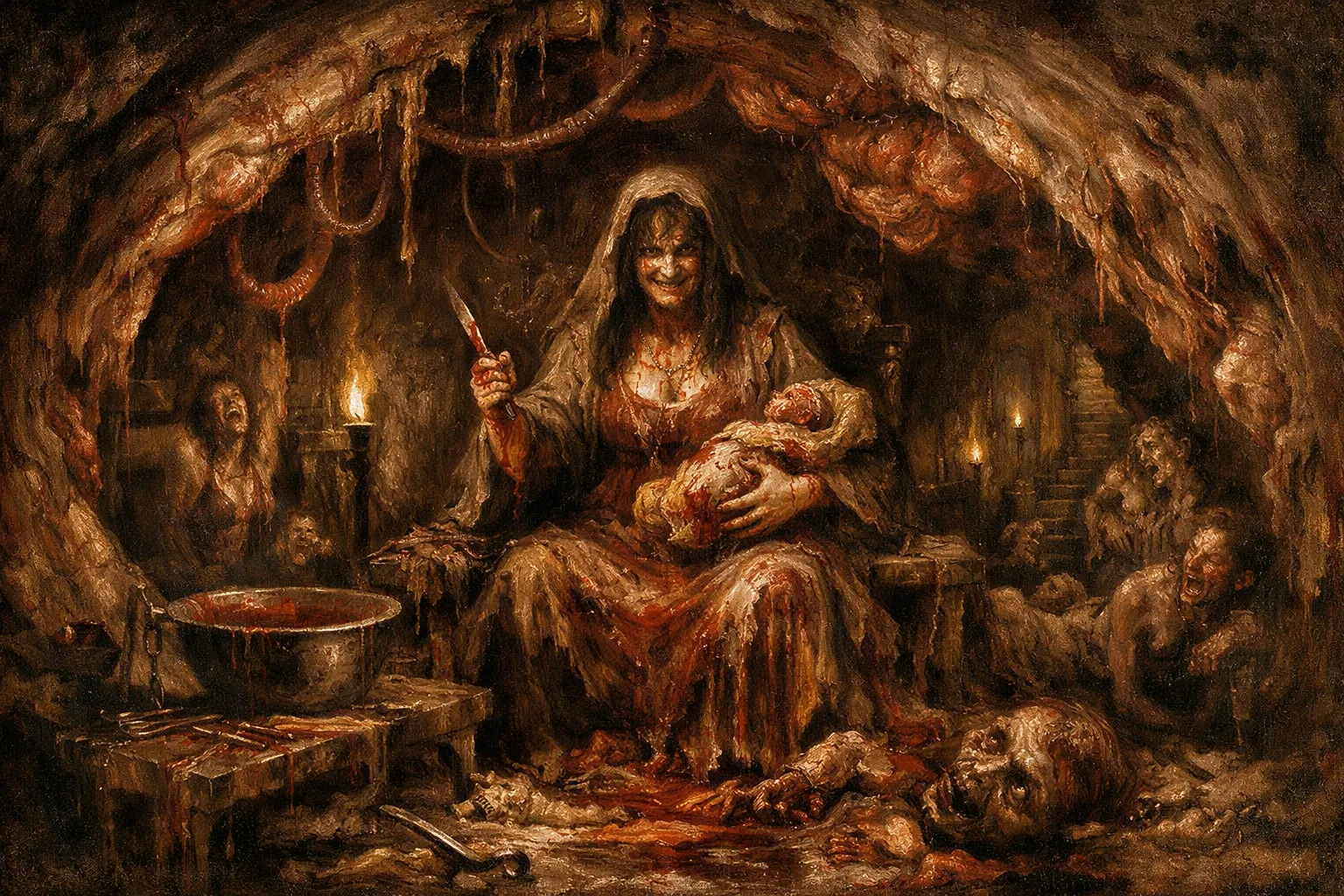
The maternal instinct, once codified by the socius, becomes the most efficient delivery system for fascism, wrapping the brutal machinery of exclusion in the soft, suffocating blanket of unconditional love.
I. The Familial War Machine: Oedipus as the Engine of Terror
Mother's Day (2010) is not a home invasion film; it is a schizoanalytic diagram of the family unit as a micro-fascist state. The Koffin family, returning to their foreclosed home, enacts a violent re-territorialization of space. The house, stripped of its legal ownership by the bank (the Abstract Machine of Capital), is reclaimed through the imposition of a localized, tyrannical Law: the Law of the Mother.
The Mother (Rebecca De Mornay) functions as the Despotic Signifier. She is the central node in a Paranoid Machine that codes all external reality as a threat and all internal violence as a necessity. Her arrival shifts the film’s energy from the chaotic, molecular violence of the brothers (a disorganized pack) to a cold, molar strategy of domination. She disciplines her sons not to stop their violence, but to refine it—to move from the clumsy "bark" to the lethal "bite."
"Mother: No. I said don't bark. Wait and then bite."
This instruction is the pedagogical core of fascist subjectivation. The subject (Addley) is taught to suppress the immediate, expressive flow of rage (barking) in favor of a calculated, instrumental violence (biting). This is the cultivation of Character Armor (Reich, 1949). The Mother demands that her sons armor themselves against empathy and impulse, channeling their libidinal energy into a focused, destructive force that serves the family unit. The slap she delivers to Addley ("Don't ever strike a woman") is a schizoid paradox: she uses violence to enforce a code of chivalry, proving that the Law is always suspended for the Sovereign. She embodies the state of exception (Agamben, 2005); she is the law-giver who stands outside the law, authorized to inflict pain to maintain the "purity" of the family code.
This dynamic illustrates how the Oedipal machine (Deleuze & Guattari, 1983) serves as the breeding ground for fascism. The sons’ desire is entirely captured by the Mother; they seek her approval, her gaze, her validation. Their violence against the hostages is a displaced expression of their repressed desire for maternal union. They destroy the "Other" (the hostages) to prove their fidelity to the Same (the Family).
II. The Banality of Evil: Normalizing the Monstrous
The Mother’s ability to oscillate between horrific violence and maternal tenderness is the cinematic realization of Hannah Arendt’s "banality of evil" (Arendt, 1963). She is not a cartoon villain; she is "terribly and terrifyingly normal." Her evil is not rooted in sadism per se, but in her absolute commitment to a specific, exclusionary rationality: the survival and supremacy of her bloodline.
This normality is the true horror. When she weeps over the photo of the Sohapis' dead child, her empathy is real, but it is segmented. She can feel the loss of a child in the abstract while simultaneously burning the photo to torture the father. This schizoid split allows her to maintain a self-image of nobility ("I am a good mother") while engaging in acts of monstrosity. She has successfully compartmentalized her desiring-machines, allowing the flow of sentimentality to coexist with the flow of torture without contradiction.
"From the viewpoint of our legal institutions and of our moral standards of judgment, this normality was much more terrifying than all the atrocities put together." (Arendt, 1963, p. 276)
The Mother’s fascism is domestic. It is the belief that the family is a sovereign nation, entitled to defend its borders with lethal force. The hostages are not people; they are biopolitical waste, impediments to the family’s resource acquisition. This mirrors the logic of the State, which uses the rhetoric of "national security" (or "family values") to justify the liquidation of external threats. The Koffin family is a microcosm of the imperialist nation-state, exporting violence to secure its own domestic comfort.
III. The Counter-Fascism of Individualism: Beth as the Capitalist Subject
Against the Mother’s tribal fascism, the film positions Beth Sohapi (Jaime King) as the embodiment of neoliberal individualism. Beth is not a hero; she is a survivalist entrepreneur. Her strategy is the commodification of relationships. She sells out her friends—the doctor, the business owner—trading their safety for her own.
Beth represents the Capitalist Desiring-Machine in crisis. Faced with the collapse of the social contract, she reverts to the primary axiom of the market: self-interest. She views her friends not as a collective to be defended, but as assets to be liquidated. Her "survival of the fittest" ethic is the mirror image of the Mother’s tribalism. While the Mother sacrifices the Other for the Group, Beth sacrifices the Other for the Self. Both are forms of anti-production, blocking the formation of a genuine collective revolutionary subject.
Beth’s actions expose the fragility of the bourgeois social contract. Under pressure, the polite veneer of friendship dissolves, revealing the underlying competitive structure of capitalist relations. Everyone is a potential competitor for the limited resource of survival. Beth effectively becomes a micro-fascist of the self, willing to destroy the social body to preserve her own biological continuity.
IV. The Failure of the Collective: Fragmenting the "We"
The only potential line of flight from this binary of competing fascisms is represented by Treshawn Jackson (Lyriq Bent). Treshawn attempts to rally the hostages, to create a collective consciousness capable of resisting the Koffin machine. He thinks in terms of "we," trying to forge a nomadic war machine (Deleuze & Guattari, 1987) out of the disparate, terrified individuals in the basement.
However, the film systematically dismantles this possibility. The Mother’s strategy—"turn everyone against each other"—is a masterful application of divide and conquer. She attacks the social bonds, the economic ties, and the sexual fidelities of the hostages. By forcing them to witness and participate in each other’s humiliation, she destroys the possibility of solidarity (Freire, 2000). The group is fragmented into isolated, terrified monads, incapable of coordinated action.
The invasion mirrors the tactics of KKK terror campaigns: the goal is not just destruction, but the psychological disintegration of the community. By violating the sanctity of the home and forcing the victims to betray one another, the aggressor destroys the intersubjective trust necessary for resistance. The hostages are left with no "we," only a collection of broken "I"s.
The film’s conclusion, where the survivors are left traumatized and isolated, confirms the victory of the divisive machine. The collective Body-without-Organs—the potential for a unified, revolutionary force—has been successfully stratified and partitioned by the violence of the State-Family. The Mother may be defeated, but her logic prevails: in the end, it is every family (or every individual) for themselves.
The viewer is left to confront the uncomfortable truth: the nuclear family, when stripped of its sentimental disguises, is a machine built for war, and the "love" of a mother can be the most terrifying fuel for the fascist engine.
References
Agamben, G. (2005). State of Exception. (K. Attell, Trans.). University of Chicago Press.
Arendt, H. (1963). Eichmann in Jerusalem: A Report on the Banality of Evil. Viking Press.
Deleuze, G., & Guattari, F. (1983). Anti-Oedipus: Capitalism and Schizophrenia. (R. Hurley, M. Seem, & H. R. Lane, Trans.). University of Minnesota Press.
Deleuze, G., & Guattari, F. (1987). A Thousand Plateaus: Capitalism and Schizophrenia. (B. Massumi, Trans.). University of Minnesota Press.
Freire, P. (2000). Pedagogy of the Oppressed. (M. B. Ramos, Trans.). Continuum.
Reich, W. (1949). Character Analysis. (T. P. Wolfe, Trans.). Orgone Institute Press.
Comments
Post a Comment