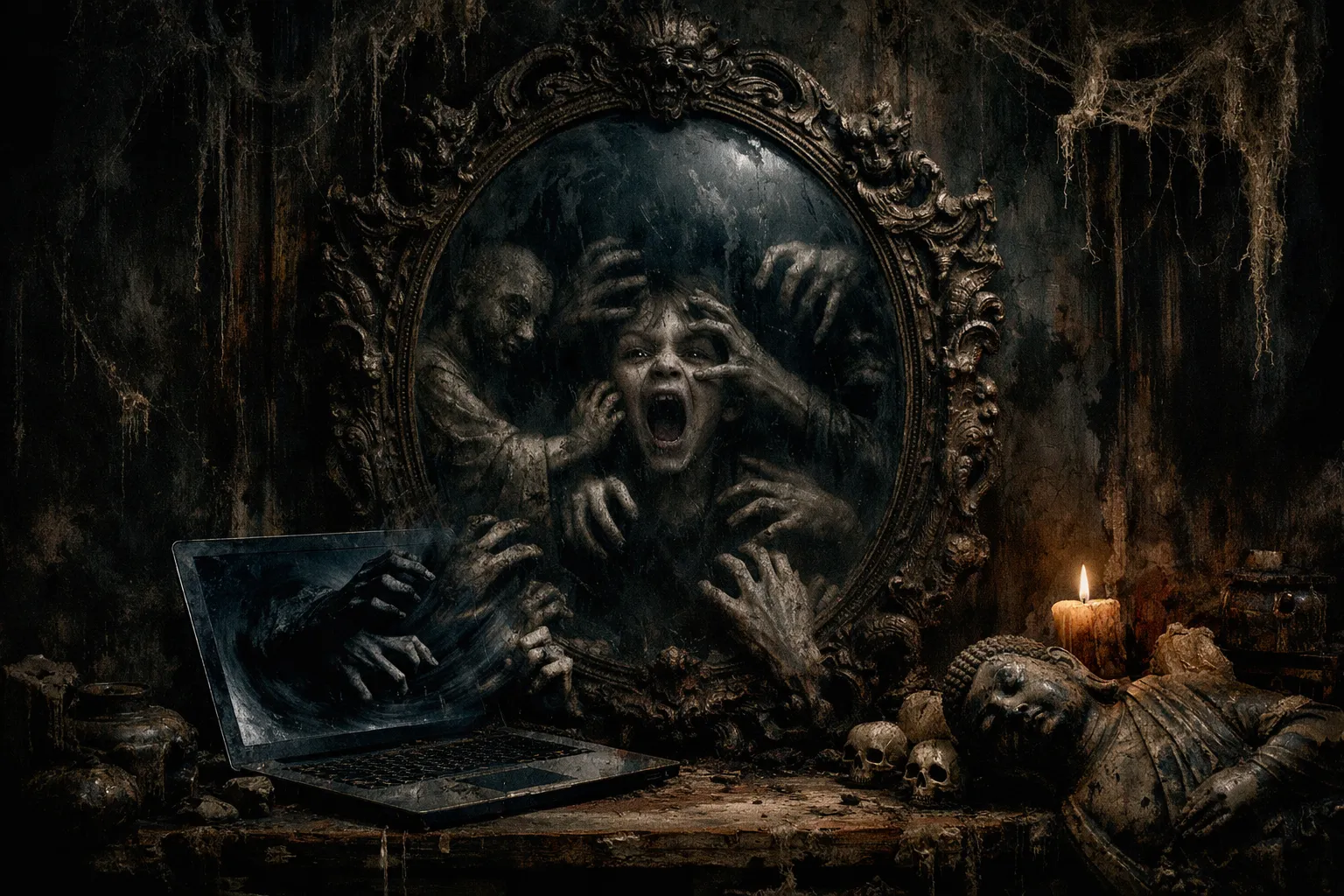
The mirror does not wait for you to look into it; it looks first, drafts a version of you, and then politely asks you to step inside.
Haunted Glass as a Pluralist Hellscape
We pretend horror movies are about the monster, but Oculus is about the room itself—the frame that decides what counts as real, sane, and rememberable. The Lasser Glass hangs on the wall like a smug transcendental condition: before there is “experience,” there is this surface that will pre-format whatever passes through it.
This is where the film quietly overlaps with pluralist debates inside Mahāyāna Buddhism. A tradition that can host countless Buddhas, bodhisattvas, and contradictory sutras has long had to invent “strategies of demarcation, inclusivism and tolerance” just to survive its own multiplicity (Sakuma, 2016). The trick is to say: many paths, but somehow still one Dharma; many images of awakening, but still one emptiness.
The Lasser Glass is a fascist parody of that move. It, too, welcomes many worlds—visions, false memories, overlapping timelines—but only so they can be bent toward a single project: the slow digestion of a family. The mirror is inclusivist the way an intestinal tract is pluralist: every food is welcome, none leaves unchanged.
In a genuinely pluralist Mahāyāna logic, difference is not merely tolerated but treated as a skillful means—another vehicle for beings to encounter emptiness and compassion (Sakuma, 2016). In Oculus, difference is tolerated as long as it lubricates the mirror’s control: multiple realities, yes; multiple interpretations, yes; but always within a closed appliance. Pluralism without an outside.
This is where schizoanalysis begins to sniff around the frame. Not in an explanatory textbook way, but as a feral suspicion: this mirror is not a “symbol” of trauma—it is a desiring-machine plugging into every outlet in the house, rerouting flows of affection, work, memory, and fear into its own circuit (Deleuze & Guattari, 1983). The more interpretations it generates, the more tightly it binds the family to its glossy, murderous surface.
Family Values, Capitalist Despair, and the Domestic Lab
The suburban home is laid out as a micro-factory of subjectivity. Father in the office, mother in the bedroom and kitchen, children in the playroom, each room a workstation for a particular form of normalized desire. Marx was not being metaphorical when he said that in capitalism, relations between people take on the character of relations between things; the house in Oculus is literally organized by the commodities that govern each space—screens, files, dishes, mirrors (Marx, 1976).
The father’s office is a miniature disciplinary regime: screens, deadlines, invisible superiors, pornography as a privatized relief valve for frustration. Foucault’s analysis of discipline shows us that power works less by direct violence than by structuring the space, the timetable, and the field of visibility in which bodies move (Foucault, 1977). The Lasser Glass, relocated into that office, becomes the apex supervisor, a panopticon folded into a decorative frame. It sees without being seen; it watches not only what the father does, but what he wishes he could do and hates himself for wanting.
Reich would call the father’s rigid posture, his muttered irritability, his sexual secrecy a form of “character armor,” a muscular and emotional shell formed under patriarchal and economic pressures (Reich, 1949/1972). That armor is supposed to protect him from collapse. Instead, the mirror plays with it like a cat with a toy: whispering new images, feeding him the fantasy of escape in the form of an incorporeal, spectral woman who lives in the glass.
The mother’s body is equally over-coded by domestic expectation. She is supposed to be the soft center of the home: nurturing, sexually available, emotionally stabilizing. When the mirror begins to infest her perception—turning her own reflection into a bruised, fragmented enemy—it is not simply “possession.” It is the point where the impossible demands of ideal femininity, the constant self-surveillance in the age of perfect images, and the raw cruelty of an inhuman object line up.
Foucault notes that the modern soul is not a pre-existing essence but “the prison of the body,” a product of disciplinary apparatuses that teach us to observe and judge ourselves (Foucault, 1977). Oculus shows a woman whose prison starts talking back: the mirror that taught her to arrange her hair now teaches her to distrust the skin beneath it. Her breakdown is both supernatural and perfectly ordinary, a convergence of demonology and domestic burnout.
The children are the raw material passing through this factory. Schizoanalysis refuses to see them as innocent blanks; they are tiny desiring-machines already spliced into the circuits of parental anxiety, mortgage payments, and horror-movie fandom (Deleuze & Guattari, 1983). Kaylie returns as an adult not because she is “unable to move on” but because she has been fully produced as the subject who will feed herself—and everyone she loves—back into the experiment.
The Mirror Stage with Teeth
Psychoanalysis taught us to be suspicious of mirrors long before horror cinema did. Lacan’s mirror stage describes the child’s jubilant misrecognition: seeing a coherent image of the body and taking it as “me,” even though the lived experience of the body is clumsy, fragmented, overflowing (Lacan, 1977). Identity is born in a kind of ecstatic error.
Oculus is that scene replayed with the joy stripped out. The siblings do not see themselves in the Lasser Glass; they see whatever the apparatus requires to keep them in orbit. A familiar hallway becomes longer, a bowl of fruit becomes shards of glass, a lover’s call becomes a mockery. The mirror offers coherence only as bait, and only for as long as it takes to lead them into more radical disorientation.
Freud describes the “compulsion to repeat” as the mind’s strange tendency to re-enact painful scenarios rather than simply seeking pleasure, as if some deeper drive is trying to master or rewrite the trauma by staging it again and again (Freud, 1920/1955). The family’s return to the house—Tim from the institution, Kaylie armed with her devices—feels at first like that repetition: the scene restaged in order to be overcome.
But in the schizoanalytic register, the repetition is not simply psychic; it is machinic. The mirror itself repeats families the way a factory repeats widgets on an assembly line. Each iteration is a test of its settings. The compulsion to repeat has been externalized into an appliance that runs on electricity and human screams.
Lacan insists that desire is not a straight line toward an object but a structural effect of the symbolic order itself, the way language and law carve the subject into lack (Lacan, 1977). The Lasser Glass hijacks that architecture: it becomes the third term in every relationship. You do not simply want food, you want food as seen through the mirror’s corrections.
The horror is not that the mirror “isn’t real”; the horror is that it becomes more real than your own sensory memory. Where Kant imagined a transcendental subject that imposes the basic forms of time and space on experience, Oculus imagines a transcendental object that quietly rewires those forms from the outside (Kant, 1998). Duration, sequence, location: all can be patched and updated remotely.
Simulation, Streaming, and the Mirror as Algorithm
When Baudrillard talks about simulation, it is the claim that our epoch is flooded by models and codes that no longer even pretend to refer back to a stable reality (Baudrillard, 1994). The Lasser Glass is a pre-digital algorithm. It does not merely project illusions; it collects data on which illusions work.
This is why Oculus feels eerily contemporary in the age of recommendation engines and content feeds. Our own “mirrors”—phones, laptops, platforms—offer us pluralism as an endless buffet of micro-worlds, yet always within a closed ecosystem that learns from every click. Mahāyāna pluralism wanted to choreograph difference toward liberation; algorithmic pluralism choreographs difference toward deeper capture (Sakuma, 2016).
Baudrillard notes that once the simulation is dense enough, critique tends to be folded back in as another sign (Baudrillard, 1994). Kaylie’s entire investigative apparatus is instantly turned into set dressing for the mirror’s latest performance. Žižek remarks that ideology today works by structuring the space in which we act and enjoy, so that even our cynical distance becomes part of the system’s lubrication (Žižek, 2006). The algorithm does not fear your doubt; it harvests it.
Buddhas in the Basement: Mahāyāna Ghosts and Hungry Mirrors
In the cosmology of many Mahāyāna traditions, there is a realm of hungry ghosts—beings with enormous stomachs and pinhole throats, perpetually starving. The Lasser Glass is a hungry ghost made hardware. Pluralism within Mahāyāna often operates via radical inclusivism, reinterpreting folk rituals as provisional manifestations of the Buddha’s skillful means (Sakuma, 2016).
The mirror mimics this inclusivism but subtracts compassion. It takes in every symptom—psychosis, PTSD, dysfunctional family dynamics—and says: “Yes, yes, all of this is real, but more deeply, it is my doing.” From another angle, Buddhist thought of emptiness ($śūnyatā$) claims that all phenomena are empty of fixed self-nature, interdependent, and momentary. Oculus gives us a perverse anti-emptiness: an ontological free-for-all in which the only stable point is the predator on the wall.
Nietzsche writes of a world without underlying metaphysical guarantees, where the absence of God opens the possibility of affirming life in its chaotic multiplicity (Nietzsche, 1974). In Oculus, affirmation fails. The plural perspectives never crystallize into a joyful “yes.” They become an anxiety spiral.
Events That Don’t Quite Happen
Badiou reserves the name “event” for those moments that rupture the given situation and open a new space of truth (Badiou, 2001). The shattering of the mirror should be such an event. Kaylie designs her entire setup waiting for that single intervention—the anchor on a timer.
Instead, the moment is swallowed. The anchor is triggered at exactly the wrong time. Rather than a new truth emerging, the old apparatus of law and psychiatry is reinforced. From Badiou’s angle, we might say: there was no event here, only a failed attempt at one. The mirror ensures that every would-be rupture is folded back into business as usual (Badiou, 2001).
Kant’s critical project was to describe the conditions under which experience as such is possible: the a priori forms of intuition (space, time) and the categories of the understanding (Kant, 1998). Oculus stages what it feels like when our lived, practical trust in those conditions fails. What Badiou calls “fidelity to the event” becomes, in Oculus, fidelity to a nightmare.
Desiring-Machines and Surplus Enjoyment
From the perspective of Anti-Oedipus, the family’s drama is never just “family drama.” It is a montage absorbing flows from the workplace, media, and the unconscious (Deleuze & Guattari, 1983). Freud’s death drive appears here as the observable willingness of characters to walk back into rooms they know are lethal (Freud, 1920/1955).
Žižek’s notion of surplus-enjoyment—the enjoyment we get not from satisfying a need but from circling endlessly around it—helps explain our own position as viewers (Žižek, 2006). We do not watch Oculus to see the problem solved; we watch to savor the repetition of its failure.
Toward a Different Kind of Pluralism
Sakuma’s analysis notes that strategies of inclusivism can serve both liberative and conservative functions (Sakuma, 2016). The Lasser Glass is a demonic parody of the latter. What would a genuinely schizoanalytic response look like? Not another heroic lone investigator, but a reconfiguration of the assemblage: communal living that breaks the isolation of the nuclear home and practices of attention that teach us to see mirrors as tools, not shrines.
Marx dreamed of a world where the products of human labor no longer confront us as alien powers but are managed as collective creations (Marx, 1976). In such a world, a haunted object would be a failed joke. The Lasser Glass wins in Oculus because it is the only stable collective point in the film. Everything revolves around it.
References
Badiou, A. (2001). Ethics: An Essay on the Understanding of Evil. Verso.
Baudrillard, J. (1994). Simulacra and Simulation. University of Michigan Press.
Deleuze, G., & Guattari, F. (1983). Anti-Oedipus: Capitalism and Schizophrenia. University of Minnesota Press.
Foucault, M. (1977). Discipline and Punish: The Birth of the Prison. Pantheon.
Freud, S. (1955). Beyond the Pleasure Principle. In The Standard Edition of the Complete Psychological Works of Sigmund Freud (Vol. 18). Hogarth Press. (Original work published 1920).
Kant, I. (1998). Critique of Pure Reason. Cambridge University Press.
Lacan, J. (1977). Écrits: A Selection. W.W. Norton & Company.
Marx, K. (1976). Capital: A Critique of Political Economy (Vol. 1). Penguin Books.
Nietzsche, F. (1974). The Gay Science. Vintage.
Reich, W. (1972). Character Analysis. Farrar, Straus and Giroux. (Original work published 1949).
Sakuma, H. (2016). Pluralism in Mahāyāna Buddhism: Strategies of Demarcation, Inclusivism and Tolerance. In Religions, 7(2).
Žižek, S. (2006). The Parallax View. MIT Press.
Comments
Post a Comment