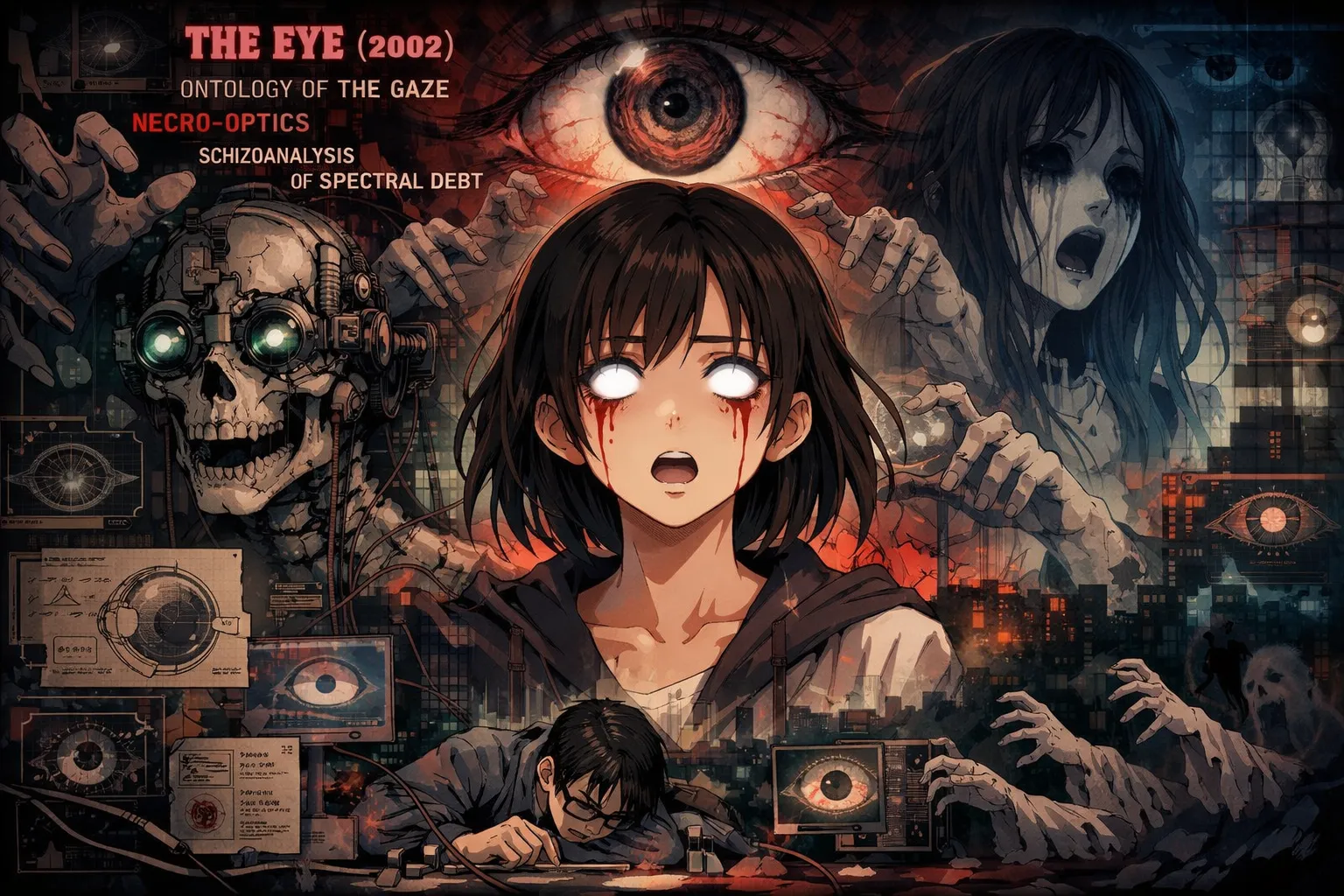
The eye is not a window; it is a butcher’s knife that carves the world into consumable shapes, a desiring-machine that eats light and excretes meaning.
The gaze correlates space between our body and the objects in the world. It is an act of violent sorting. To look is to cut. Objects call upon vision to be distinguished from the background noise of existence; a chair sprouts up among other objects—table, rug, floor—demanding to be seen as a tool for sitting. As we mobilize our body through the world, the position of our gaze shifts, and we gaze with movement. The image of the thing gazed at enters our face and becomes conceptualized in relation to its symbolic reality.
But what happens when the object refuses to be a chair? If we took our chainsaw to the chair and buzzed it to pieces, the chair becomes symbolically and physically disintegrated, yet haunted by its previous meaning. The parts—chunks of wood and fabric—become individualized as we look down upon our destruction. There is a sense in which being alongside a complete chair hides the molecular meaning of its components. In The Eye (2002), the transplant is the chainsaw. Mun, having received corneal transplants after a lifetime of blindness, does not merely "gain sight"; she is violently inserted into a regime of visuality that she cannot decode. Her vision is not a restoration but a deterritorialization of her previous sensory world.
I. The Tactile Void and the Tyranny of the Image
Mun’s initial state is one of tactile sovereignty. Blindness forced her brain to allocate and identify meaning physically through touching. The world was haptic, intimate, and proximate. When she is thrust into the visual field, she is referred to a shrink to establish connections between the image of an object and its meaning.
Consider the stapler. When the shrink holds it up, Mun instinctively reaches to touch it. From her perspective, the visual stapler is an unknown and inaccessible object, a floating signifier without a signified. She has the same relationship to the stapler that an infant has to a rattle: pure, uncodified sensory data. The shrink’s demand—“What is this?”—is the imposition of the Symbolic Order (Lacan, 2006). He is forcing her to submit to the tyranny of the image, to accept that the visual representation is the thing itself.
This pedagogical violence mirrors the Foucauldian discipline of the clinic (Foucault, 1973). Mun is not being healed; she is being calibrated. Her "seeing" is a learned behavior, a stratification of her chaotic sensory input into the acceptable, molar forms of the dominant reality. But the transplant carries a residual charge—a ghost-code—that resists this calibration. The eyes she inherited are not neutral lenses; they are desiring-machines imprinted with the trauma of their previous owner. They do not just see; they remember.
II. The Hallway of the Real: Spectral Interventions
After Mun's eye surgery, she awakes and wanders from her hospital bed. She finds herself in a long hallway. Her eyes are still adjusting to sight, and she sees a figure at the other end. She calls out for it. The scene flips between the viewer’s clear perspective and Mun's fuzzy, deterritorialized perspective. We know she is confronting a ghost. But she is alienated from the possibility of an intervention of the transcendent.
This moment is the irruption of the Real (Lacan, 1977). The figure is a hole in the visual field, a presence that defies the symbolic logic she is trying to learn. Suddenly, the ghost disappears, leaving her unsure of her visual orientation towards reality. At this point, the idea that her new eyes have given her the capacity to see ghosts is suspended; the viewer is provided with clear evidence, but Mun is left in ontological insecurity (Laing, 1960). She cannot trust her own senses because her senses are not hers—they are foreign agents grafting a nightmare onto her brain.
Sartre (1956) argues that "Only the dead can be perpetually objects without ever becoming subjects-for to die is not to lose one's objectivity in the midst of the world... But to die is to lose all possibility of revealing oneself as a subject to an Other" (p. 321). The ghosts in The Eye defy this Sartrean death. They are attempting to become subjects again. They are desperate desiring-machines trying to reconnect with the world of the living. The ghost lacks the materiality to be fully seen, yet it taunts Mun with fragments of meaning.
The scene where the ghost intervenes in her reality by shifting the sight of her room between Mun's known reality and the room the ghost died in is a schizoid fluctuation. It is a superimposition of two distinct space-times. The ghost, denied embodiment by its condition of death, is denied access to a clear capacity for sending a message. It can only transmit intensities—cold, fear, the image of the room itself. Mun becomes the medium through which the ghost attempts to re-territorialize its trauma.
III. The Necro-Optic Gaze: Demanding Recognition
The ghost is demanding to be seen. Why is it important for the ghost to be recognized? We learn at the end of the movie that the ghost's backstory is suicide induced by her community turning on her when she confronted them with her premonition of fire. The community gazed upon her and associated a meaning that negated the systems that gave value to herself, and she hung herself.
Caught in a purgatorial cycle where she hangs herself every night while her mother abandoned her to her choice, the ghost died ignored and unrecognized. She returns to compel Mun's authentic gaze upon the tragedy. This is a demand for witnessing as a form of liberation theology (Freire, 2000)—the oppressed (the dead) demanding that the oppressor (the living) acknowledge their suffering.
Mun’s eyes are the vehicle for this acknowledgment. They are the organs of debt. Because she sees through the dead girl's corneas, she inherits the dead girl's unresolved trauma. The vision is not a gift; it is a haunting, a forced labor of seeing what the world refuses to see.
"When we are in direct connection with the Other by language and when we gradually learn what he thinks of us, this is the thing which will be able at once to fascinate us and fill us with horror." (Sartre, 1956, p. 288).
The horror Mun feels is the horror of being interpellated by the dead. She is no longer just Mun; she is the Subject-Who-Sees. The ghosts are not just scary images; they are social relations frozen in the moment of death, demanding to be thawed by the heat of her gaze.
IV. The Becoming-Ghost and the Body-without-Organs
Mun’s journey is a becoming-ghost. As she investigates the origins of her eyes, she begins to lose her own identity and merge with the donor, Ling. This is a molecular becoming (Deleuze & Guattari, 1987). She adopts Ling’s perspective, her memories, her pain. She is deterritorializing from her own life and re-territorializing onto Ling’s tragic narrative.
The climax, where Mun confronts the fire that killed Ling’s community, is the final schizo-synthesis. She is both Mun and Ling, seeing the disaster before it happens, powerless to stop it yet compelled to witness it. The fire is the absolute deterritorialization, the force that wipes away the village and the people, leaving only the trauma.
Mun’s final act—blinding herself by staring into the sun/fire/glass—is the ultimate refusal. It is a line of flight back into darkness. She rejects the regime of the visible that has brought her nothing but terror. By destroying her sight, she destroys the connection to the ghosts. She re-claims her body by shutting down the desiring-machine of the eye. She chooses the smooth space of blindness over the striated space of the haunted visual field.
She becomes a Body-without-Organs once more, impervious to the images that sought to colonize her. In the darkness, she finds peace. The screen goes black. The machine stops.
References
Deleuze, G., & Guattari, F. (1983). Anti-Oedipus: Capitalism and schizophrenia (R. Hurley, M. Seem, & H. R. Lane, Trans.). University of Minnesota Press.
Deleuze, G., & Guattari, F. (1987). A Thousand Plateaus: Capitalism and schizophrenia (B. Massumi, Trans.). University of Minnesota Press.
Foucault, M. (1973). The Birth of the Clinic: An Archaeology of Medical Perception (A. M. Sheridan Smith, Trans.). Pantheon.
Freire, P. (2000). Pedagogy of the Oppressed (30th Anniversary Edition). Continuum.
Lacan, J. (1977). The Four Fundamental Concepts of Psychoanalysis (A. Sheridan, Trans.). W. W. Norton & Company.
Lacan, J. (2006). Écrits: The First Complete Edition in English (B. Fink, Trans.). W. W. Norton & Company.
Laing, R. D. (1960). The Divided Self: An Existential Study in Sanity and Madness. Tavistock Publications.
Sartre, J. P. (1956). Being and Nothingness: A Phenomenological Essay on Ontology (H. E. Barnes, Trans.). Philosophical Library.
Comments
Post a Comment